I. Introduction — The Return of Big-Picture National Investment
For much of the past few decades, economic success has been framed in terms of markets, GDP growth, and corporate performance. Yet for many households, the economy feels very different at ground level. Families measure stability through housing affordability, childcare costs, job security, and whether their communities are improving or declining.
That gap between national economic indicators and lived experience is fueling renewed discussion around large-scale, place-based investment — the kind that focuses not just on growth, but on making everyday life more livable.
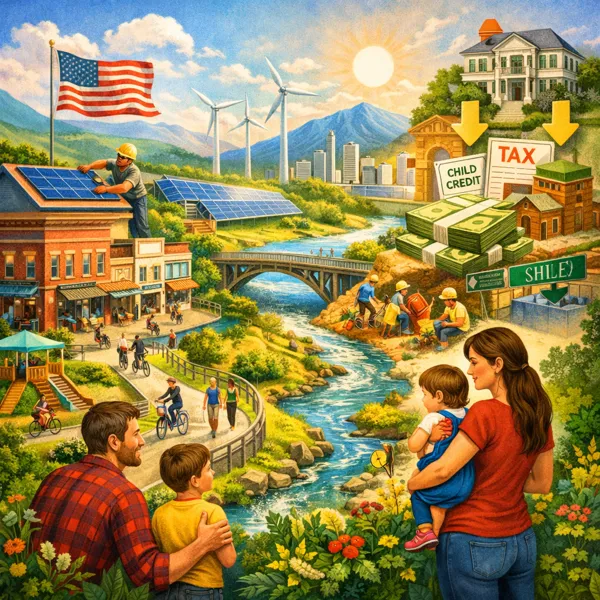
A modern, livability-focused national investment strategy would center on strengthening the foundations of daily life:
- Revitalizing small and mid-sized cities
- Expanding trails, parks, and public spaces
- Supporting families through child-focused tax credits
- Investing in energy and infrastructure projects
- Funding long-term investment through progressive taxation
The underlying idea is simple but powerful: when communities become more affordable, connected, and family-friendly, economic strength tends to follow.
This is not about recreating the past. It’s about applying the same scale of thinking to modern challenges — housing costs, declining birth rates, regional inequality, and aging infrastructure. The goal would be to invest directly in the places where people live, work, and raise families.
This post explores the concept from a big-picture perspective — where it comes from, why it’s gaining attention, and how a modern framework could reshape local economies and household finances over time.
II. Historical Context — What the Original New Deal Actually Did
To understand why a large-scale national investment strategy is being discussed again, it helps to look at the historical precedent.
The original New Deal emerged during one of the most severe economic crises in U.S. history. The Great Depression left millions unemployed, local economies collapsed, and infrastructure across the country was underdeveloped or deteriorating. The response was not a single program but a coordinated effort to stabilize communities and rebuild the nation’s economic foundation.
Key pillars of that era included:
Job creation through public works
- Roads, bridges, schools, and public buildings
- Dams, water systems, and electrification projects
- Conservation and park development
Long-term infrastructure investment
- Rural electrification expanded access to power
- Transportation networks connected regions
- Public spaces and parks improved quality of life
Expansion of the social safety net
- Programs designed to provide stability for vulnerable households
- Systems meant to reduce the risk of future economic collapse
The lasting impact wasn’t just immediate employment. Much of the infrastructure built during that period shaped communities for generations. Parks, trails, water systems, and public buildings created then still serve millions today.
The key lesson from that period is not about copying specific policies. It’s about recognizing the broader approach: large-scale investment aimed at stabilizing households, strengthening communities, and building long-term economic capacity.
III. Why a Modern Version Is Being Discussed Now
Today’s challenges are different, but they share a similar structural character. Instead of mass unemployment, the pressures are more gradual and persistent — and they often show up in household budgets and community trends.
Several long-term forces are converging:
Declining birth rates
- Families are delaying or having fewer children
- Cost of raising children is a growing factor
Housing affordability pressures
- Home prices rising faster than wages in many regions
- Rent consuming a larger share of income
Rising cost of daily life
- Childcare, healthcare, and education costs continue to climb
- Middle-income households feeling squeezed
Regional economic inequality
- Growth concentrated in a limited number of metro areas
- Small and mid-sized cities struggling to retain population and jobs
Aging infrastructure
- Roads, water systems, and public facilities needing modernization
- Energy systems facing new demands
These pressures don’t always show up clearly in national statistics, but they shape the lived experience of millions of households.
This is why the idea of focusing on livability is gaining traction. If people decide where to live, work, and raise families based on affordability, safety, and opportunity, then improving those conditions becomes a form of economic strategy.
It raises an important framing question:
What if the next phase of national investment focused less on maximizing growth metrics and more on improving the quality of life in communities across the country?
That shift in focus — from abstract performance to lived experience — is what makes the concept of a modern, livability-focused investment strategy feel relevant again.
IV. Focus Area 1 — Revitalizing Small Cities and Regional Economies
One of the defining economic trends of the past several decades has been the concentration of opportunity in a relatively small number of major metropolitan areas. High-growth regions have attracted talent, capital, and jobs, while many small and mid-sized cities have struggled to keep pace.
This shift has created a widening gap in opportunity, affordability, and long-term stability between regions.
A. The Structural Challenge
Many smaller cities and regional communities are facing:
- Population stagnation or decline
- Limited job diversity
- Aging infrastructure
- Downtown business district deterioration
- Reduced tax base growth
At the same time, large metro areas are facing the opposite problem:
- Rising housing costs
- Infrastructure strain
- Congestion and long commutes
A modern national investment approach could help rebalance this dynamic by directing targeted resources toward communities with strong potential but limited capital access.
B. Potential Policy Tools
A revitalization strategy could include:
Infrastructure modernization
- Road and bridge repair
- Water system upgrades
- Broadband expansion for remote work and business development
- Regional transportation connections
Local economic development
- Incentives for small business formation
- Workforce training aligned with local industries
- Support for regional manufacturing and service sectors
Housing revitalization
- Grants to renovate aging housing stock
- Incentives for first-time homebuyers
- Mixed-income housing development
These investments create local employment immediately while strengthening long-term economic foundations.
C. Why This Matters Economically
Revitalizing smaller cities is not just a regional issue — it’s a national economic strategy.
Benefits include:
- Reducing pressure on overcrowded metro housing markets
- Spreading job growth more evenly across regions
- Stabilizing local tax bases
- Creating more affordable options for families
Over time, stronger regional economies can support more balanced national growth.
V. Focus Area 2 — Trails, Parks, and Public Spaces as Economic Assets
Public spaces are often viewed as amenities rather than economic drivers. But in practice, they play a meaningful role in how communities develop, attract residents, and maintain long-term stability.
Investments in trails, parks, and recreation areas can deliver both economic and social returns.
A. Types of Projects That Fit This Model
A livability-focused investment strategy might support:
- Walking and biking trail networks
- Riverfront and waterfront redevelopment
- Expansion of city and regional parks
- Conservation corridors and greenbelts
- Community gathering spaces
These projects are visible, local, and widely used — making them some of the most immediately impactful investments.
B. Economic Effects at the Local Level
Well-designed public spaces often lead to:
- Increased property values near parks and trails
- Growth in tourism and recreation spending
- Support for local retail and restaurants
- Health benefits that can reduce long-term public health costs
They also improve the day-to-day experience of living in a community, which can influence whether people stay, move, or invest locally.
C. Why These Projects Are Politically Durable
Compared to more abstract economic initiatives, public space investments tend to have broad appeal because they are:
- Highly visible
- Accessible to everyone
- Locally beneficial
- Job-creating during development
They offer a rare combination of economic development, community improvement, and quality-of-life enhancement in one package.
VI. Focus Area 3 — Supporting Families Through Child Tax Credits and Cost Relief
One of the most significant financial pressures facing households today is the cost of raising children. Housing, childcare, healthcare, and education expenses have all risen substantially over time, and many families feel squeezed from multiple directions.
Supporting families is often framed as social policy, but it also has clear economic implications.
A. The Financial Reality of Raising Children
For many households, major expenses include:
- Childcare costs that rival housing payments in some regions
- Healthcare and insurance expenses
- Education-related costs
- Larger housing needs as families grow
These pressures can lead families to delay major life decisions, including having children, purchasing homes, or relocating for opportunity.
B. Policy Options That Could Ease Pressure
A family-focused investment strategy might include:
Expanded child tax credits
- Larger per-child benefits
- Credits targeted toward middle-income households
- Options for periodic or monthly payments
Childcare cost relief
- Tax credits for childcare expenses
- Incentives to increase childcare availability
- Support for early childhood programs
Education support measures
- Credits tied to after-school programs
- Incentives supporting learning resources and enrichment
These types of policies directly increase disposable income for families and reduce financial stress during high-expense years.
C. The Economic Logic Behind Family Support
From an economic perspective, supporting families can have ripple effects that extend beyond individual households:
- Increased workforce participation, particularly among parents
- Greater financial stability for middle-income families
- More predictable long-term population trends
- Stronger consumer spending in local economies
When families feel financially stable, they are more likely to invest in homes, education, and their communities — all of which contribute to broader economic strength.
Taken together, policies that reduce the cost of raising children function not just as household support, but as long-term investments in workforce stability and community continuity.
VII. Focus Area 4 — Green Infrastructure as a Jobs and Cost Strategy
Energy and environmental investments are often discussed through the lens of climate policy, but they are just as much about household economics, job creation, and long-term cost stability. A modern national investment framework would likely treat green infrastructure as core economic infrastructure — similar to highways, water systems, and electrification projects in earlier eras.
A. Potential Investment Areas
A large-scale initiative could focus on projects such as:
- Solar installations for communities, schools, and public buildings
- Grid modernization to improve reliability and efficiency
- Battery storage systems to stabilize energy supply
- Home weatherization and energy efficiency retrofits
- Localized energy resilience projects in smaller cities
These types of projects tend to be labor-intensive, regionally distributed, and capable of supporting both skilled and semi-skilled jobs.
B. Household-Level Impacts
Energy infrastructure investments can directly affect monthly budgets and long-term financial stability.
Potential benefits include:
- Lower long-term utility costs through efficiency improvements
- More predictable energy pricing over time
- Increased reliability and fewer disruptions
- Reduced maintenance costs for older energy systems
For households, this means energy becomes less of a financial wildcard and more of a manageable, stable expense.
C. Local Economic Development Effects
Green infrastructure can also act as an economic catalyst.
- Creates construction, technical, and maintenance jobs
- Supports regional supply chains and manufacturing
- Encourages workforce training in high-demand fields
- Attracts businesses seeking stable, modern infrastructure
When paired with small-city revitalization efforts, energy investment can anchor long-term economic growth in communities that need it most.
VIII. Making Livability a Core Economic Strategy
At its core, this entire framework rests on a shift in how economic success is defined. Traditional metrics like GDP, stock market performance, and corporate earnings are important, but they don’t always capture how households experience the economy day to day.
Livability focuses on the conditions that shape real life.
A. What Actually Drives Where People Choose to Live
Most families make location decisions based on practical factors, including:
- Housing affordability
- Safety and community stability
- School quality
- Job availability
- Commute times
- Access to nature and recreation
These factors influence not just where people live, but whether they stay long term, start families, and invest in their communities.
B. Livability as Economic Development
When communities invest in quality of life, they often see measurable economic benefits:
- Attraction of young workers and families
- Increased property demand and stability
- Stronger local business activity
- Improved workforce retention
In this way, livability becomes a form of economic infrastructure — just as important as roads or utilities.
C. The Feedback Loop
A livability-centered strategy creates a reinforcing cycle:
- Investments improve daily life
- Communities become more attractive
- Population stabilizes or grows
- Local economies strengthen
- Tax bases expand
- More reinvestment becomes possible
Over time, this kind of feedback loop can reshape regional economies and reduce the stark differences between booming metros and struggling smaller cities.
IX. Funding the Vision — Taxing High-Income Wealth Concentration
Any large-scale national investment effort ultimately comes down to one critical question: how is it paid for? One of the most commonly discussed approaches is funding through increased taxation on higher-income households, large estates, or concentrated wealth.
This is where the conversation becomes more complex and often more contentious.
A. Common Funding Proposals
Ideas frequently discussed in policy circles include:
- Higher top marginal income tax rates
- Adjustments to capital gains taxation
- Estate tax expansion
- Corporate tax changes
- Minimum tax frameworks for high earners
The general principle behind these proposals is the “ability-to-pay” model — directing more of the funding responsibility toward those with the greatest financial capacity.
B. Arguments in Favor
Supporters of progressive funding approaches often point to several potential benefits:
- Provides revenue for long-term national investments
- Helps address structural inequality
- Directs resources toward community-building initiatives
- Strengthens public systems that support workforce growth
Historically, major infrastructure expansions in the United States were often paired with higher top marginal tax rates, though today’s economy is more globally interconnected and complex.
C. Concerns and Tradeoffs
At the same time, there are legitimate economic questions that must be considered:
- How taxation affects investment behavior
- Capital mobility in a global economy
- Corporate competitiveness
- Political feasibility and policy stability
Balancing revenue generation with economic incentives is one of the central challenges of designing any long-term national investment strategy.
Ultimately, the debate is less about whether investment is needed and more about how to fund it responsibly while maintaining economic growth and stability.
X. Economic Case — Why Large-Scale Public Investment Can Work
A national investment strategy centered on livability isn’t just about improving communities — it’s rooted in long-standing economic theory about how public investment supports private growth, workforce stability, and long-term productivity.
When done well, infrastructure and community investment can produce multiplier effects that extend far beyond the initial spending.
A. The Multiplier Effect of Infrastructure Spending
Historically, infrastructure investment has been associated with:
- Immediate job creation in construction and skilled trades
- Increased demand for materials and local services
- Improved transportation and efficiency for businesses
- Long-term productivity gains
When communities gain better roads, energy systems, broadband, and public spaces, businesses operate more efficiently and households face fewer barriers to mobility and employment.
B. Reducing Household Cost Pressures
A livability-focused investment model aims to reduce structural expenses that strain family budgets, including:
- Transportation costs through better infrastructure
- Utility costs through energy efficiency upgrades
- Childcare and education expenses through targeted support
- Housing pressures through regional development
Lower fixed costs can increase disposable income, which in turn supports consumer spending — a major driver of economic growth.
C. Strengthening Long-Term Productivity
Public investment can also shape long-term national competitiveness by:
- Improving workforce mobility
- Supporting regional workforce participation
- Enhancing infrastructure that businesses rely on
- Stabilizing communities where labor markets are weakening
When people can afford to live where jobs exist — or when jobs expand into more affordable regions — productivity tends to increase organically.
D. The Household-Level Outcome
At the individual level, the economic logic comes down to stability:
- More predictable expenses
- Stronger employment opportunities
- Greater community investment
- Higher confidence in long-term planning
These factors influence major financial decisions like buying a home, starting a business, or raising a family — all of which shape long-term economic growth.
XI. Risks, Criticisms, and Counterarguments
Any large-scale policy framework of this magnitude will come with real tradeoffs and legitimate concerns. Addressing these openly is essential to having a balanced conversation.
A. Government Efficiency Concerns
Critics often question whether large public programs:
- Allocate resources efficiently
- Avoid waste or mismanagement
- Deliver results evenly across regions
Public investment programs vary widely in effectiveness, and outcomes depend heavily on execution, oversight, and long-term planning.
B. Fiscal Sustainability
Large investments raise important questions about long-term fiscal health:
- Deficit impacts
- Debt sustainability
- Competing budget priorities
Some argue that significant new spending could place pressure on future taxpayers if not balanced with stable revenue sources.
C. Tax Policy Tradeoffs
Funding through higher taxation on high-income households or corporations introduces additional debate points:
- Potential shifts in investment behavior
- Business location decisions
- Long-term competitiveness concerns
Supporters often emphasize that strong infrastructure and stable communities support business growth, while critics focus on possible economic disincentives.
D. Uneven Results Across Regions
Not every community benefits equally from national programs.
Challenges may include:
- Some areas seeing stronger returns than others
- Local capacity to manage projects effectively
- Differences in workforce readiness
This makes targeting and program design critical to achieving balanced outcomes.
E. Political and Policy Stability
Large-scale initiatives require long time horizons, but policy direction can shift with election cycles. That creates uncertainty around:
- Long-term funding continuity
- Regulatory stability
- Project completion timelines
For investments to succeed, they often require sustained commitment across multiple administrations.
XII. Who Benefits Most?
A livability-centered national investment strategy would likely have broad effects, but certain groups and regions could see especially meaningful impact.
A. Small and Mid-Sized Cities
Communities outside major metro areas could benefit from:
- New infrastructure investment
- Increased job opportunities
- Population stabilization
- Revitalized housing markets
These areas often have strong foundations but lack capital investment.
B. Young Families and Middle-Income Households
Policies focused on childcare costs, tax credits, housing affordability, and livability improvements could:
- Reduce financial pressure during peak family-building years
- Increase disposable income
- Support long-term financial stability
This group often feels the greatest squeeze from rising living costs.
C. Workers in Infrastructure and Skilled Trades
Investment-driven projects can increase demand for:
- Construction workers
- Electricians and technicians
- Engineers and project managers
- Local service providers
This creates employment opportunities across skill levels and regions.
D. Regional Economies and Local Businesses
As communities improve and populations stabilize, local businesses often benefit from:
- Increased consumer spending
- More predictable customer bases
- Revitalized commercial districts
- Stronger local economic ecosystems
E. The Broader Economy
Over time, the broader national economy may benefit from:
- More balanced regional growth
- Reduced housing pressure in major metros
- Higher workforce participation
- Stronger long-term population stability
At its core, the goal is to support the households and communities that form the foundation of economic life — not just the sectors that generate the most headlines.
XIII. Long-Term National Outcomes — A Generational Perspective
If a livability-focused investment strategy were implemented and sustained over time, the most meaningful effects would likely emerge over decades rather than years. This is not about quick stimulus or short-term economic boosts. It’s about reshaping the structural conditions that determine where people live, work, and raise families.
A. Population Stability and Family Formation
One of the most significant long-term questions facing developed economies is demographic stability. Birth rates have declined across much of the developed world, and in many regions of the United States, younger households are delaying major life decisions due to cost pressures.
Reducing the financial burden tied to:
- Housing
- Childcare
- Education
- Healthcare
could make it easier for families to plan for the future. Over time, policies that improve stability may support:
- More predictable population trends
- Greater household confidence
- Stronger community continuity
B. Regional Economic Balance
When economic growth concentrates heavily in a few major metros, it can create long-term imbalances:
- Housing shortages in high-growth areas
- Population decline in smaller communities
- Uneven job opportunities
Investing in smaller cities and regional hubs may gradually help distribute opportunity more evenly. Over time, that can lead to:
- Reduced migration pressure into a handful of urban centers
- Stronger local economies in overlooked regions
- More affordable living options across the country
C. Reduced Cost-of-Living Pressure
If infrastructure, housing, and energy investments successfully reduce structural costs, households may experience:
- Lower utility expenses
- More stable housing markets
- Reduced transportation costs
- Better access to services close to home
These types of changes don’t always show up immediately in economic data, but they can reshape financial stability across generations.
D. Stronger Household Financial Health
When communities are stable and daily costs are more manageable, families are better positioned to:
- Save for emergencies
- Invest for retirement
- Purchase homes
- Start small businesses
Over time, stronger household balance sheets contribute to broader economic resilience.
E. A Shift Toward Long-Term Thinking
Perhaps the most significant outcome of a large-scale investment approach is a change in time horizon. Instead of focusing primarily on short-term growth cycles, the emphasis moves toward building systems and communities that support stability over decades.
XIV. Tables
Table 1: Investment Areas vs Household Impact
| Investment Area | Immediate Effect | Household-Level Benefit | Long-Term Outcome |
|---|---|---|---|
| Child tax credits | Higher disposable income | Easier to afford childcare & essentials | Family stability |
| Parks & trails | Local job creation | Health, recreation, and quality of life | Property value growth |
| Small city investment | Infrastructure upgrades | More local job opportunities | Regional population stability |
| Green energy projects | Energy system modernization | Lower utility costs over time | Energy resilience |
| Housing revitalization | Renovation and development activity | Expanded housing access | Stronger communities |
Table 2: Small Cities vs Major Metros — Structural Tradeoffs
| Factor | Small & Mid-Sized Cities | Major Metro Areas |
|---|---|---|
| Housing costs | Typically lower | Typically higher |
| Job concentration | Lower but growing | Very high |
| Growth pressure | Less intense | Often strained |
| Infrastructure needs | Modernization and reinvestment | Expansion and maintenance |
| Livability potential | High with investment | Varies by affordability |
Table 3: Livability Investments and Economic Ripple Effects
| Livability Investment | Short-Term Result | Long-Term Economic Effect |
|---|---|---|
| Public spaces & parks | Construction jobs | Tourism, property stability |
| Child-focused tax relief | More household cash flow | Higher workforce participation |
| Energy infrastructure | Skilled job creation | Lower household operating costs |
| Regional development | Local business activity | Balanced national growth |
These tables help translate big ideas into tangible household-level outcomes.
XV. Conclusion — A Shift from Growth Alone to Quality of Life
For much of modern economic policy, success has been measured primarily through growth metrics: GDP, productivity, and market performance. Those indicators still matter, but they don’t fully capture how people experience the economy in their daily lives.
A livability-focused investment strategy represents a shift in emphasis:
- From markets → to households
- From short-term cycles → to long-term stability
- From concentrated growth → to regional balance
At its core, this kind of approach is about strengthening the foundation of everyday life — where people live, raise children, and build their financial futures.
Revitalized small cities, expanded public spaces, family-focused tax relief, and modern infrastructure all connect back to one central idea: strong communities support strong economies.
If the places people live become more affordable, more connected, and more stable, the ripple effects can influence migration patterns, workforce participation, housing markets, and long-term financial security.
That leads to a larger, generational question worth considering:
What ultimately drives lasting prosperity — faster economic growth, or better places to live?
The answer may shape how the next era of national investment is defined.