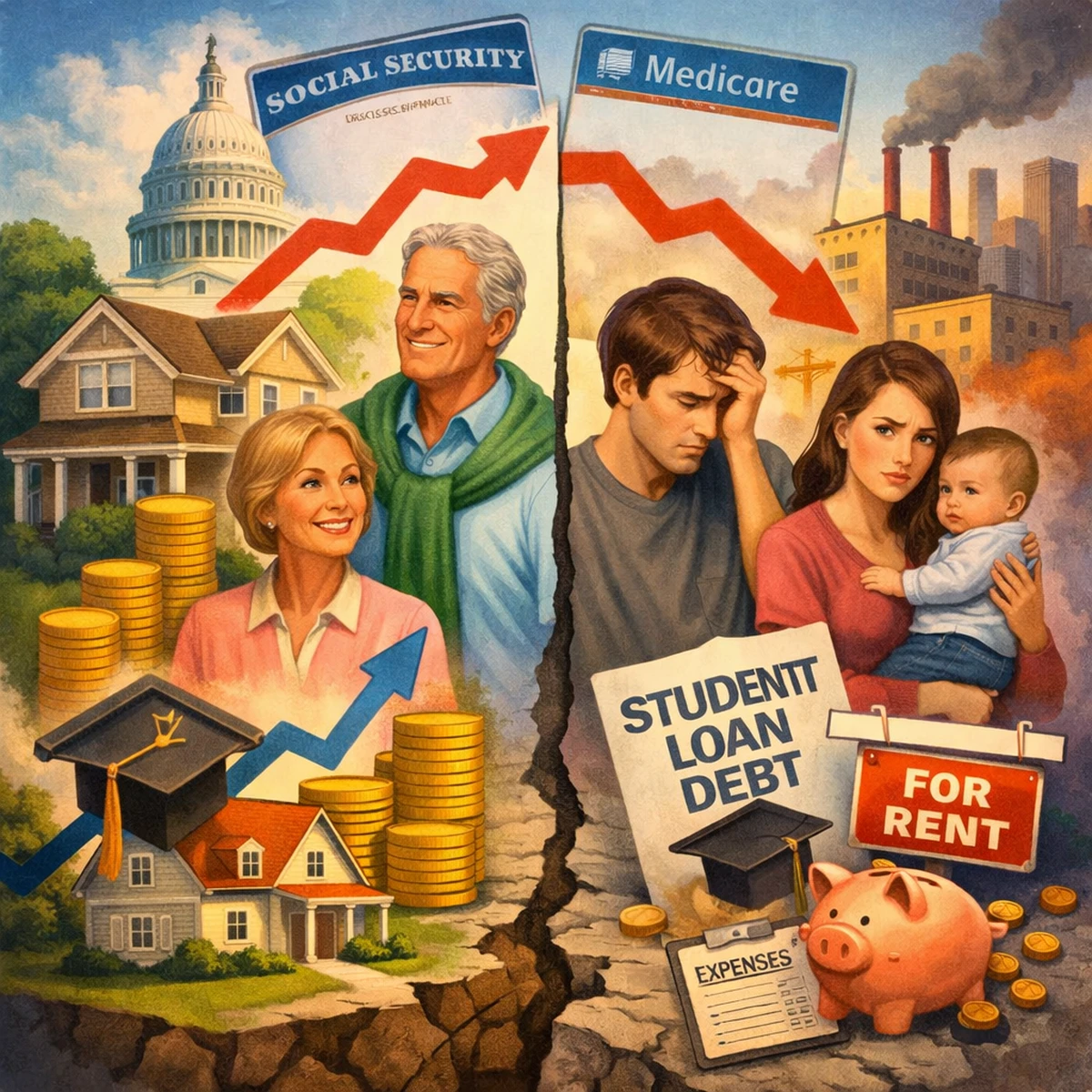
I. Introduction: A Structural Challenge, Not a Blame Game
The United States has experienced one of the most dramatic generational wealth shifts in modern economic history. The Baby Boomer generation—born between 1946 and 1964—came of age during a period of expanding homeownership, strong wage growth, accessible public higher education, and relatively affordable family formation.
Today, younger generations face a very different starting line.
This is not about faulting individuals for responding rationally to the incentives of their time. It is about examining how long-term policy choices—across multiple administrations and parties—interacted with demographic voting power, asset inflation, and tax design to produce unintended consequences.
Over decades, policies that stabilized markets, supported asset prices, and reduced certain tax burdens disproportionately benefited those who already owned homes and financial assets. Meanwhile, structural cost pressures—college tuition, housing, childcare, healthcare—rose faster than median wages for many younger households.
The result is a widening generational wealth divide and increasing financial insecurity at the system level.
The central question is not whether one generation “caused” this outcome. The more important question is:
Have long-standing policy incentives gradually shifted opportunity forward in time, leaving younger families to shoulder higher costs and greater risk?
And if so, how do we rebalance for generational fairness without destabilizing the system?
II. The Policy Landscape That Shaped Today
1. Tax Policy and Asset Appreciation
Over the past 40 years, tax policy has gradually shifted in ways that favor capital over labor.
Key changes include:
- Reductions in top marginal income tax rates
- Lower capital gains tax rates
- Expanded estate tax exemptions
- Favorable treatment of dividends and investment income
These policies were often justified as pro-growth, pro-investment measures. In many cases, they did support asset market expansion.
But asset ownership is highly concentrated. Older households hold a disproportionately large share of:
- Housing equity
- Stock market wealth
- Retirement accounts
As interest rates fell after the 2008 financial crisis—and again during the COVID-era monetary response—asset prices rose dramatically.
This was not accidental. Monetary policy was designed to stabilize the economy. But a side effect of asset-supportive policy is wealth amplification for those already holding assets.
If you owned a home before 2012, you benefited significantly from price appreciation.
If you owned equities during the 2010s bull market, you saw substantial portfolio growth.
If you were entering the housing market in 2022, you faced record-high prices and rising rates.
This dynamic widened wealth gaps between:
- Homeowners and renters
- Stockholders and wage earners
- Older and younger households
It also made entry into wealth-building channels more capital-intensive.
📊 Table 2: Inflation-Adjusted Growth Since 1980
Source basis: BLS CPI components, Census income data, Case-Shiller housing index
| Category | Real % Increase Since 1980 |
|---|---|
| Median Household Income | ~25–30% |
| Public 4-Year College Tuition | ~180–220% |
| Healthcare Spending Per Capita | ~120–150% |
| Median Home Price | ~100–120% |
Interpretation:
Core life-stage costs (education, healthcare, housing) rose far faster than median income growth.
This creates structural friction for:
- Family expansion
- Household formation
- Down payment accumulation
2. College Costs and the Shift to Household Financing
In the 1970s and early 1980s, public higher education was heavily subsidized. Tuition was low relative to median income.
Over time:
- State funding per student declined in many regions
- Tuition rose faster than inflation
- Federal student lending expanded
The cost burden shifted from institutions to households.
Student loan balances expanded into the trillions.
For many younger Americans, adulthood now begins with:
- Significant debt
- Delayed savings
- Reduced down payment capacity
- Postponed marriage and childbearing
Education remains a powerful economic ladder. But the financing model changed.
That shift interacts with housing affordability, family formation timing, and long-term wealth accumulation.
3. Housing Supply Constraints and Rising Entry Barriers
Housing is the primary wealth-building vehicle for the middle class.
But over the past several decades:
- Zoning restrictions tightened in many high-opportunity areas
- Starter homes became less common
- Land-use constraints limited new supply
- Urban demand increased
Meanwhile, low interest rates supported home price growth.
The result:
- Median home prices rose faster than median wages in many metro areas
- First-time homebuyer age steadily increased
- Family assistance became more important for down payments
Recent data show first-time buyers are older than in previous generations and often have higher incomes or intergenerational support.
Delayed homeownership delays wealth accumulation.
Delayed wealth accumulation delays family formation.
These are not isolated trends. They reinforce one another.
📊 Table 3: Median Age of First-Time Homebuyers
Source basis: National Association of Realtors Historical Profile of Home Buyers
| Year | Median Age of First-Time Buyers |
|---|---|
| 1981 | 29 |
| 1991 | 28 |
| 2001 | 30 |
| 2011 | 31 |
| 2021 | 33 |
| 2023 | 35 |
| 2024–2025 (est.) | 36–38 |
Additional Context:
- Median age of all homebuyers in 2023–2024 exceeded 40.
- First-time buyers now often require higher incomes or family financial assistance.
Implication:
Homeownership — historically the middle-class wealth engine — is delayed by nearly a decade compared to the early 1980s.
III. The Generational Wealth Divide
The Baby Boomer generation now controls a substantial share of national wealth.
That is partly due to:
- Demographic size
- Asset market appreciation
- Early entry into affordable housing markets
- Stronger pension coverage in earlier decades
Younger generations entered adulthood in very different macroeconomic environments:
- Post-2008 labor markets
- Rising tuition and student debt
- Elevated housing price-to-income ratios
- Greater job volatility
Wealth compounds over time. Entering asset markets earlier and at lower price points produces powerful cumulative effects.
This has created a generational wealth gap that is structural, not emotional.
At the same time, entitlement programs like Medicare and Social Security rely on:
- Payroll tax growth
- A stable worker-to-retiree ratio
Lower fertility rates and delayed family formation reduce the future tax base that supports these systems.
The irony is that policies designed to protect stability for one generation may, over time, create fiscal pressure on the system that supports everyone.
This is not a moral indictment.
It is a structural feedback loop.
📊 Table 1 : Median Net Worth by Generation (Inflation Adjusted)
Source basis: Federal Reserve Survey of Consumer Finances 1989–2022, age-adjusted comparisons
| Generation | Approximate Current Age | Median Net Worth (2022 SCF, 2023$) | Notes |
|---|---|---|---|
| Silent Generation | 78–95 | ~$290,000 | Benefited from long housing appreciation + pensions |
| Baby Boomers | 60–78 | ~$205,000 | Peak asset exposure during major housing & equity booms |
| Gen X | 44–59 | ~$192,000 | Hit by 2008 crisis during prime earning years |
| Millennials | 28–43 | ~$84,000 | Entered workforce post-2008, delayed homeownership |
Key Insight:
Boomers hold roughly 50%+ of total U.S. household wealth, despite being a shrinking share of the population.
IV. Why This Is Creating Systemic Financial Insecurity
The issue is no longer simply about intergenerational wealth gaps. It is about system stability.
When wealth accumulation becomes increasingly dependent on asset ownership — and entry into those assets is delayed or restricted — economic resilience weakens at the household level.
Several reinforcing pressures are now visible:
1. Delayed Family Formation and Lower Fertility
Family formation has become more expensive and more financially risky.
Younger households face:
- Higher housing price-to-income ratios
- Student debt burdens
- Rising childcare costs
- Elevated out-of-pocket medical costs for childbirth
- Less employer-provided benefit stability
When economic security is uncertain, major life decisions are postponed.
Delayed homeownership delays wealth accumulation.
Delayed wealth accumulation delays marriage and childbearing.
Lower fertility reduces long-term workforce growth.
Over time, this feeds directly into entitlement solvency challenges. Medicare and Social Security depend on a stable payroll tax base. When the worker-to-retiree ratio declines, structural financing pressure increases.
This is not theoretical. Trust fund projections already reflect it.
2. Asset-Driven Inequality and Reduced Mobility
When policy environments favor asset appreciation — whether through tax design or monetary stabilization — wealth becomes increasingly concentrated among those who already own appreciating assets.
This creates:
- Higher barriers to entry for younger households
- Greater reliance on family transfers for down payments
- Intergenerational wealth stratification
Mobility slows when opportunity depends more on inherited capital than earned income.
Over time, a society where upward mobility declines becomes economically fragile. Middle-class expansion historically fueled American growth. A thinner middle class reduces consumer stability, entrepreneurial risk-taking, and long-term economic dynamism.
3. Fiscal Pressure and Political Paralysis
The same demographic and economic trends that widen wealth gaps also pressure public finances.
Lower fertility and slower wage growth mean:
- Slower payroll tax growth
- Greater entitlement strain
- Rising interest costs as debt accumulates
At the same time, high-turnout older voters are understandably protective of benefits they paid into for decades.
This creates political gridlock:
- Younger households struggle with affordability
- Older households resist abrupt entitlement changes
- Lawmakers delay structural reform
Delay does not remove pressure. It compounds it.
The longer adjustments are postponed, the sharper they become when they finally occur.
4. Erosion of Long-Term Confidence
Economic systems function not just on numbers, but on confidence.
If younger generations perceive:
- That upward mobility is narrowing
- That starting a family is financially destabilizing
- That asset ownership is increasingly unattainable
Then long-term economic participation weakens.
When long-term confidence erodes, so does:
- Entrepreneurship
- Labor force participation
- Political cohesion
This is what systemic insecurity looks like — not collapse, but gradual strain.
V. A Non-Partisan Path Toward Generational Fairness
If the problem is structural, the solutions must also be structural.
Generational fairness does not require punitive redistribution. It requires recalibrating incentives to strengthen the economic foundation for all age groups.
The goal is balance — preserving earned benefits while restoring opportunity.
Below are realistic areas of reform that cut across party lines.
1. Align Tax Policy With Long-Term Workforce Growth
Small, targeted adjustments can reduce long-term strain:
- Gradual payroll tax base expansions for high earners
- Adjustments to capital gains timing or estate thresholds
- Policies that reduce distortion between labor and capital taxation
The objective is not to penalize wealth creation — but to ensure that tax design supports long-term solvency and workforce participation.
Even modest changes, implemented early, significantly improve projections.
2. Expand Housing Supply and Entry Pathways
Housing affordability is foundational to middle-class stability.
Policy tools include:
- Zoning reform to increase starter-home construction
- Incentives for high-density housing near job centers
- Reduction of regulatory barriers that restrict supply
- First-time buyer savings vehicles
Housing reform may be the single most powerful lever for reducing delayed wealth accumulation.
Supply, not just subsidy, matters.
3. Reduce Family Formation Friction
If demographic stability matters, family formation should not be financially destabilizing.
Policies that have broad support across ideological lines include:
- Expanded and stable child tax credits
- Targeted childcare support
- Paid parental leave frameworks
- Simplified healthcare billing transparency
Even modest reductions in early-family financial strain improve long-term labor participation and stability.
4. Stabilize Entitlement Programs Gradually
Generational fairness does not require sudden benefit cuts.
But it does require forward-looking adjustments:
- Gradual eligibility adjustments tied to longevity
- Means-testing at the highest wealth tiers
- Payroll tax rate calibrations implemented slowly
- Immigration policies aligned with workforce sustainability
Small changes now prevent large disruptions later.
📊 Table 4: Worker-to-Retiree Ratio (Social Security & Medicare Context)
Source basis: Social Security Trustees Reports, SSA projections
| Year | Workers Per Retiree |
|---|---|
| 1960 | 5.1 : 1 |
| 1980 | 3.2 : 1 |
| 2000 | 3.4 : 1 |
| 2025 | ~2.8 : 1 |
| 2040 (projected) | ~2.3 : 1 |
What This Means:
Lower fertility + longer life expectancy + delayed family formation =
Fewer workers supporting more retirees.
That structural shift drives Medicare and Social Security solvency pressure — independent of party control.
5. Encourage Broader Asset Ownership
If asset appreciation continues to drive wealth growth, access to asset ownership must broaden.
Potential approaches:
- Expanded retirement account access
- Automatic enrollment savings mechanisms
- Financial literacy education tied to workplace benefits
- Incentives for employee equity participation
When more households participate in capital markets, asset-driven inequality narrows.
6. Reframe the Conversation
The most important shift is rhetorical:
This is not Boomers versus Millennials.
It is not left versus right.
It is about restoring structural balance.
Older generations acted within the policy frameworks of their time.
Younger generations face different starting conditions.
The objective is not retribution. It is recalibration.
Conclusion: Shared Stability Requires Shared Adjustment
Economic systems evolve. Demographics change. Asset markets cycle.
But the middle class remains the stabilizing force in democratic economies.
When opportunity narrows, systems strain.
When family formation becomes financially precarious, long-term growth slows.
When policy incentives compound wealth concentration, intergenerational trust weakens.
Generational fairness is not about undoing the past.
It is about designing forward-looking policy that:
- Preserves earned benefits
- Expands opportunity
- Strengthens workforce growth
- Reduces structural friction for young families
Small, steady adjustments now are less disruptive than forced correction later.
The question is not whether reform is needed.
The question is whether it happens deliberately — or reactively.