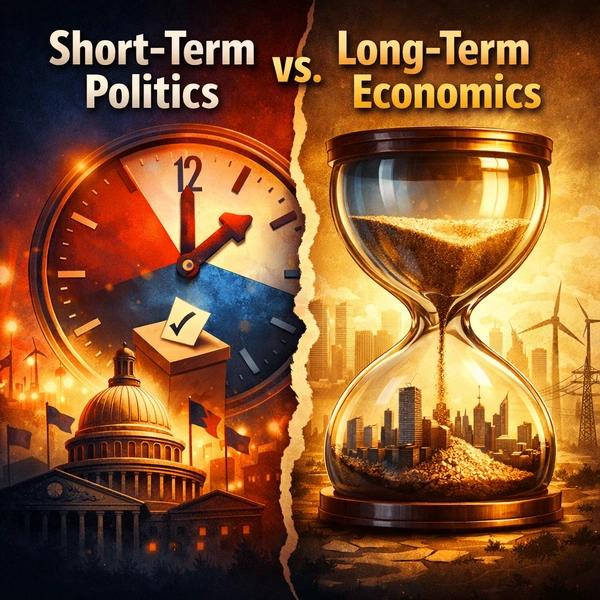
I. Introduction — The Time Horizon Problem
Modern political systems operate on short clocks. Elections arrive every few years. News cycles reset every few hours. Public attention shifts with each new crisis or headline. Yet the economic systems these political decisions shape move far more slowly. Investments in infrastructure, education, energy, and labor productivity unfold over decades. Debt compounds across generations. Demographic change reshapes economies over half-centuries.
This creates a fundamental tension: policies are decided in years, but their consequences last for decades.
A tax cut passed today can shape government finances for thirty years. A regulatory change enacted in one legislative session can determine whether an industry modernizes or stagnates over a generation. Infrastructure neglected for political convenience may not visibly fail for twenty years—until failure becomes unavoidable and far more expensive to repair.
At the center of this problem lies a structural mismatch in incentives. Political success is measured in approval ratings, election results, and short-term economic indicators. Economic success, however, is measured in sustained productivity, capital formation, and long-term stability. When political systems reward immediate gains while assigning long-term costs to future leaders and future voters, decision-making becomes biased toward speed rather than durability.
This mismatch helps explain why economic crises appear cyclical rather than exceptional. It helps explain why policies reverse abruptly with each change of leadership. And it helps explain why public trust erodes even when governments claim success: citizens experience instability, inconsistency, and rising long-term costs despite repeated promises of short-term relief.
The central thesis of this essay is simple:
Modern political systems are optimized for short-term approval but responsible for long-term economic outcomes. This mismatch systematically produces instability, policy volatility, and long-term economic damage—not because leaders are irrational, but because the structure of political incentives favors immediacy over sustainability.
Understanding this time horizon problem is essential for interpreting nearly every major policy debate: taxation, trade, housing, energy, healthcare, and debt. Before examining specific policies, it is necessary to understand the clock they are governed by.
II. Political Time vs. Economic Time
A. The Political Clock
Political decision-making is governed by short and rigid cycles.
Most elected officials operate within:
- Two-year cycles for legislative offices,
- Four-year cycles for executive leadership,
- Six-year cycles for longer-term legislative bodies.
These cycles impose powerful constraints. Political survival depends on delivering visible results before the next election. Policies that create immediate benefits—tax relief, spending programs, trade protections, or emergency interventions—generate faster political returns than reforms whose benefits emerge gradually.
The media environment intensifies this pressure. News cycles reward dramatic action and immediate outcomes. Long-term planning rarely produces headlines. Maintenance and prevention are invisible successes. Crisis response is politically valuable; quiet stability is not.
As a result, political incentives consistently favor:
- Policies with immediate, tangible benefits
- Programs that can be branded and defended within one term
- Actions that defer costs beyond the next election
- Avoidance of reforms that impose near-term discomfort
Even well-intentioned leaders operate within this structure. A policy that produces economic benefits in fifteen years but creates political pain today is difficult to defend in a system that measures success every few years.
B. The Economic Clock
Economic systems evolve on much longer timelines.
Consider the time horizons of major economic drivers:
- Infrastructure projects require decades to plan, build, and amortize. Roads, ports, energy grids, and water systems are designed to function for 30 to 50 years or more.
- Education and workforce development shape productivity over an entire working lifetime. Investments made today affect labor markets for generations.
- Industrial and energy transitions unfold over multiple business cycles. Shifting production systems requires stable rules and long-term capital commitments.
- Demographic changes—aging populations, fertility rates, migration—reshape economies slowly but powerfully over decades.
Economic growth depends less on sudden interventions and more on accumulated investment, institutional credibility, and predictable rules. Firms planning factories, research facilities, or energy infrastructure require confidence that policies will not be reversed with each election. Households making long-term financial decisions rely on stable tax systems, predictable inflation, and consistent labor markets.
Unlike politics, the economy cannot be rapidly recalibrated without consequences. Short-term manipulation of prices, credit, or trade conditions may provide temporary relief, but it often distorts long-term investment incentives.
Where politics rewards speed, economics rewards patience and consistency.
C. Why the Clocks Clash
The conflict between political time and economic time is not accidental. It is structural.
Benefits and costs rarely arrive simultaneously. Politicians receive immediate credit for distributing benefits—spending, tax reductions, subsidies, or protective measures. The costs—debt accumulation, inflationary pressure, misallocated capital, or reduced productivity—emerge later, often under different leadership.
This creates what economists describe as a timing asymmetry:
- Benefits are concentrated and immediate.
- Costs are diffuse and delayed.
Political systems reward visible success but rarely punish delayed consequences. A leader who stabilizes conditions temporarily may gain political capital even if the policy increases long-term fragility. A leader who imposes discipline today to prevent future crises may suffer politically despite improving long-term outcomes.
The result is predictable behavior:
- Speed is rewarded over durability.
- Delay is favored over reform.
- Volatility replaces consistency.
Economies, however, function best when rules are stable and expectations are credible. Capital formation depends on confidence. Productivity growth depends on sustained investment. Social trust depends on policy continuity.
Politics rewards immediacy; economics requires consistency.
This tension is not ideological. It is mechanical. It exists regardless of party, platform, or leadership style. When political incentives are misaligned with economic time horizons, short-term optimization becomes long-term damage.
Political Time vs. Economic Time
| Dimension | Political Time Horizon | Economic Time Horizon |
|---|---|---|
| Typical cycle length | 2–6 years (elections) | 10–50+ years (investments, demographics) |
| Success measured by | Approval, votes, headlines | Productivity, growth, stability |
| Incentive structure | Immediate visible results | Sustained long-term performance |
| Cost visibility | Low (often deferred) | High (compounds over time) |
| Risk tolerance | Short-term political risk | Long-term systemic risk |
| Planning style | Reactive, crisis-driven | Predictive, capacity-driven |
Key Takeaway
Political systems operate on election calendars. Economic systems operate on generational timelines. When policies are shaped by short political clocks but judged by long economic outcomes, instability becomes the default condition rather than the exception.
Understanding this structural mismatch is the foundation for understanding why so many policy debates produce temporary relief but long-term fragility—and why meaningful reform is so difficult to sustain.
III. Incentives for Short-Term Wins
Political behavior is often described as irresponsible or shortsighted. In reality, it is frequently rational within the structure of the system itself. Elected officials operate under incentives that reward immediate results and punish delayed benefits. This does not require bad intentions. It requires only survival within a competitive electoral environment.
A. How Political Incentives Work
Political rewards are front-loaded. Leaders gain credit for:
- Lower taxes
- Higher spending
- Emergency relief
- Trade protection
- Job creation tied to visible projects
These actions are easy to explain, easy to market, and easy to associate with a single administration. By contrast, long-term investments—such as education reform, infrastructure maintenance, or fiscal consolidation—produce benefits that emerge slowly and cannot be easily attributed to one political term.
At the same time, political costs are back-loaded. Debt, inflation, reduced productivity, and distorted investment decisions often appear years after the original policy choice. By then, responsibility is politically ambiguous. Blame can be shifted to successors, external shocks, or structural forces.
This creates a persistent asymmetry:
- Credit is immediate and personal.
- Costs are delayed and collective.
Within such a system, rational political actors will favor policies that generate short-term gains even if those policies increase long-term fragility.
B. Deferred-Cost Policies
Short-term political incentives repeatedly produce what can be described as deferred-cost governance—policies that postpone economic consequences rather than resolve underlying problems.
Common examples include:
- Borrowing instead of taxing: Financing current benefits through debt rather than matching spending with revenue.
- Subsidizing instead of restructuring: Supporting declining industries rather than allowing capital and labor to shift toward more productive uses.
- Price controls instead of supply reform: Masking inflationary pressure without addressing underlying shortages.
- Temporary emergency measures that become permanent: Crisis tools normalized into standard policy.
These approaches share a common feature: they minimize immediate pain while magnifying future adjustment costs. The longer reform is delayed, the more disruptive it becomes when it finally occurs.
In this sense, many economic crises are not sudden failures. They are accumulated consequences of repeated political decisions that favored postponement over correction.
C. The Psychology of Short-Termism
Political incentives are reinforced by human psychology.
Voters, like markets, are subject to:
- Loss aversion: Immediate losses feel more painful than future gains feel rewarding.
- Recency bias: Recent events dominate perception over long-term trends.
- Crisis framing: Visible emergencies demand action even when long-term solutions are preferable.
- Blame avoidance: Politicians who impose near-term costs risk being punished even if those costs prevent larger future harm.
These behavioral dynamics make long-term policy difficult to sustain democratically. The benefits of structural reform are often invisible at first, while the costs are immediate and concentrated. Meanwhile, the benefits of short-term relief are obvious, while the costs are abstract and deferred.
This does not imply voter irrationality. It reflects the reality that individuals experience economic pain in the present, not in forecasts. Political systems respond accordingly.
Short-termism is therefore not merely a political strategy. It is a psychological equilibrium between leaders and voters.
Short-Term Political Gain vs. Long-Term Economic Cost
| Short-Term Political Action | Immediate Benefit | Long-Term Economic Cost |
|---|---|---|
| Borrowing to fund programs | Avoids tax increases | Higher debt, reduced fiscal flexibility |
| Subsidizing declining industries | Preserves jobs temporarily | Capital misallocation, lower productivity |
| Price controls | Lowers visible prices | Shortages, distorted signals |
| Emergency stimulus extensions | Stabilizes demand | Asset bubbles, inflation risk |
| Regulatory reversals | Signals responsiveness | Investment uncertainty |
Key Takeaway
Short-term political behavior is not an anomaly. It is the predictable outcome of a system that rewards immediate benefits and diffuses long-term costs. Rational actors operating under these incentives will repeatedly choose policies that stabilize the present at the expense of the future.
Understanding this incentive structure is essential before examining the macroeconomic consequences it produces.
IV. Policy Volatility and Market Instability
When short-term political incentives dominate long-term economic planning, policy becomes unstable. Rules change frequently. Commitments weaken. Expectations fragment. Over time, this instability transmits directly into economic behavior.
A. Policy Whiplash
Political turnover increasingly produces sharp policy reversals:
- Regulatory frameworks are rewritten
- Tax codes are restructured
- Trade relationships are renegotiated
- Subsidies are introduced and withdrawn
- Industrial strategies are reversed
From a political perspective, this may represent democratic responsiveness. From an economic perspective, it introduces uncertainty into every long-term decision.
Businesses planning factories, infrastructure, or research investments must estimate not only future market conditions but also future political conditions. When laws and incentives change with each election, planning horizons shrink. Capital becomes cautious. Long-duration projects are postponed or avoided.
Instead of stable rule sets, firms face:
- Conditional incentives
- Temporary programs
- Politically contingent regulations
- Policy risk layered atop market risk
This transforms economic calculation into political speculation.
B. Market Reaction to Uncertainty
Markets price risk. Policy volatility increases it.
Unstable policy environments lead to:
- Higher required returns on investment
- Reduced long-term capital formation
- Preference for liquid and speculative assets
- Shorter business planning cycles
In such environments, it becomes rational to prioritize financial strategies over productive investment. Capital seeks flexibility rather than durability. Innovation becomes oriented toward regulatory arbitrage rather than efficiency.
The economy gradually shifts:
- From production to positioning
- From investment to hedging
- From engineering to lobbying
This does not necessarily reduce short-term growth, but it weakens the foundation of long-term productivity.
C. Institutional Credibility Erosion
Policy volatility also weakens institutions.
When rules change constantly:
- Fiscal commitments lose credibility
- Monetary independence is questioned
- Regulatory agencies appear politicized
- Long-term planning frameworks lose authority
Institutions function best when they are predictable. Their value lies not only in their decisions but in the stability of expectations they create. Once those expectations become politically contingent, trust erodes.
Over time:
- Emergency measures become permanent
- Exceptional interventions become routine
- Institutional boundaries blur
- Long-term frameworks collapse into short-term management
This further shortens time horizons across the economy. If institutions themselves are no longer anchors of stability, private actors will not behave as though stability exists.
How Policy Volatility Affects Markets
| Type of Political Volatility | Market Response | Long-Term Effect |
|---|---|---|
| Tax code changes | Delayed investment | Slower capital formation |
| Regulatory swings | Higher risk premiums | Lower productivity |
| Trade policy shifts | Supply chain restructuring | Higher costs, fragility |
| Subsidy cycles | Rent-seeking behavior | Distorted innovation |
| Crisis interventions | Asset price inflation | Financial fragility |
Key Takeaway
Policy volatility transmits political short-termism into economic behavior. Markets respond to unstable rules by shortening their own horizons. Investment becomes cautious, speculative, and politically sensitive. Institutional credibility weakens. Long-term planning becomes increasingly difficult.
In this way, short-term political incentives do not merely distort individual policies—they reshape the entire economic environment toward instability.
V. Patterns of Long-Term Economic Damage
When short-term political incentives dominate economic decision-making, the damage rarely appears all at once. Instead, it accumulates gradually, expressing itself through recurring structural problems rather than single catastrophic failures. Across different countries and eras, the same patterns tend to emerge.
A. Structural Debt Accumulation
One of the most consistent outcomes of short-term political optimization is rising public debt.
Because borrowing allows governments to provide immediate benefits without imposing immediate costs, it becomes the preferred tool for resolving political conflict. Spending can increase without raising taxes. Programs can expand without reducing others. Crises can be managed without structural reform.
Over time, this produces:
- Persistent budget deficits
- Normalization of emergency spending
- Weak incentives for fiscal discipline
- Political resistance to retrenchment
Debt accumulation is not merely a financial issue; it is a time-horizon problem. Current voters receive services and relief. Future taxpayers inherit the obligation. Because future costs are politically invisible in the present, they are systematically underweighted in policy decisions.
The result is not necessarily immediate insolvency, but a gradual erosion of fiscal flexibility. Each new shock requires more borrowing, until borrowing itself becomes a source of instability.
B. Infrastructure and Capital Decay
Infrastructure maintenance is politically unglamorous. New projects produce ribbon-cuttings and visible achievements. Maintenance produces none.
Short-term political incentives therefore bias spending toward:
- New construction over repair
- Expansion over preservation
- Emergency fixes over long-term planning
Over time, this leads to:
- Deferred maintenance backlogs
- Rising long-term replacement costs
- Reduced reliability of public systems
- Increased vulnerability to shocks
This dynamic applies not only to physical infrastructure, but also to institutional capital: regulatory capacity, technical expertise, and administrative systems. When attention is focused on short-term outcomes, long-term asset health deteriorates quietly.
What appears as sudden failure is often the visible endpoint of decades of neglect.
C. Productivity Slowdown
Sustained economic growth depends on productivity: the ability to produce more value with the same or fewer resources. Productivity growth comes from:
- Education and training
- Technological diffusion
- Capital investment
- Stable institutional frameworks
These are long-horizon investments. They require patience, continuity, and predictable policy environments.
Short-term political systems tend to:
- Prioritize consumption over investment
- Subsidize existing industries rather than foster new ones
- Emphasize job preservation over job transformation
- Reward visible employment numbers over long-term efficiency
Over time, this produces capital misallocation. Resources remain trapped in low-productivity uses. Innovation is distorted toward politically favored sectors rather than economically efficient ones.
The economy may still grow, but more slowly. Living standards rise unevenly. Structural weaknesses deepen beneath the surface of short-term stabilization.
D. Asset Inflation and Financial Fragility
When political systems favor immediate relief and stability, monetary and fiscal tools are often pushed toward prolonged accommodation.
This can contribute to:
- Excess liquidity
- Underpriced risk
- Search for yield
- Speculative behavior
Instead of flowing primarily into productive investment, capital increasingly flows into:
- Real estate
- Financial assets
- Protected sectors
- Politically favored industries
This produces asset price inflation rather than broad-based productivity growth. Wealth concentrates in asset holders. Financial fragility increases as leverage builds and risk is mispriced.
What appears as prosperity may in fact be vulnerability: rising valuations built on policy conditions that cannot be sustained indefinitely.
E. Social and Institutional Trust Erosion
Perhaps the most corrosive effect of short-term political economics is its impact on trust.
Citizens observe:
- Repeated crises
- Constant policy reversals
- Rising long-term costs
- Broken promises of stability
Over time, this generates:
- Cynicism about institutions
- Reduced compliance with rules
- Polarization over resource allocation
- Declining faith in expertise
Trust is itself an economic asset. It lowers transaction costs, stabilizes expectations, and supports long-term planning. When trust erodes, coordination becomes harder. Policy becomes more reactive. The system becomes more fragile.
Economic damage, in this sense, is not only material. It is institutional and psychological.
Patterns of Long-Term Economic Damage
| Pattern | Political Cause | Economic Outcome |
|---|---|---|
| Rising public debt | Deferred costs | Reduced future options |
| Infrastructure decay | Maintenance avoidance | Higher replacement costs |
| Productivity slowdown | Underinvestment in human capital | Lower wage growth |
| Asset bubbles | Prolonged stimulus | Financial instability |
| Trust erosion | Policy reversals | Institutional fragility |
Key Takeaway
Short-term political optimization produces long-term economic fragility. The damage does not usually appear as immediate collapse, but as cumulative degradation: rising debt, decaying capital, slowing productivity, inflated assets, and weakened trust. These are not random outcomes. They are predictable expressions of time-horizon mismatch.
VI. Why Democracies Are Especially Vulnerable
The tension between short-term politics and long-term economics can exist in any political system, but democratic systems face unique structural challenges in managing it.
A. Popular Accountability vs. Long-Term Policy
Democracies are designed to be responsive to voters. This is their strength. It is also their vulnerability when applied to long-horizon problems.
Voters experience:
- Immediate prices
- Current employment
- Present income
- Visible service levels
They do not directly experience:
- Long-term debt dynamics
- Future productivity losses
- Deferred infrastructure decay
- Demographic shifts
As a result, politicians who impose near-term costs to achieve long-term benefits risk electoral punishment. Politicians who offer immediate relief are rewarded even if the long-term consequences are negative.
This creates a structural bias:
- Pain is politically salient.
- Prevention is politically invisible.
Democracy excels at responding to crises. It struggles at preventing them.
B. Emergency Powers and Policy Normalization
Democratic systems often expand executive and fiscal powers during emergencies. This is rational in moments of crisis. However, these extraordinary measures rarely remain temporary.
Over time:
- Emergency spending becomes baseline spending
- Temporary regulations become permanent
- Crisis tools become routine instruments
- Exceptional authority becomes normalized
This gradually shifts policy away from long-term planning and toward continuous short-term management. Systems designed for stability become systems optimized for constant intervention.
The line between crisis response and ordinary governance blurs.
C. Fragmented Responsibility Across Time
Democracies distribute power across:
- Multiple branches
- Multiple levels of government
- Multiple election cycles
This disperses accountability. No single actor fully owns long-term outcomes.
A policy decision may be made by one administration, implemented by another, and paid for by a third. When negative consequences emerge, political responsibility is difficult to assign. This weakens incentives for long-term stewardship.
Instead of long-term accountability, the system rewards:
- Short-term credit claiming
- Blame shifting
- Narrative control
- Tactical positioning
Time becomes politically fragmented.
D. Competition Between Policy and Popularity
In democratic systems, economic policy must compete with popularity. Leaders must balance:
- Technical effectiveness
- Political survivability
- Media reception
- Electoral timing
Policies that are economically sound but politically difficult face structural disadvantages. Policies that are politically attractive but economically unsound face structural advantages.
This does not imply democratic failure. It implies democratic tension. The system is designed to reflect popular will, not necessarily long-term optimization.
The challenge is institutional: how to preserve democratic accountability while protecting long-horizon economic policy from short-term political pressure.
Key Takeaway
Democracies are especially vulnerable to time-horizon mismatch because they combine short electoral cycles, dispersed accountability, and strong incentives for immediate responsiveness. Their strength—popular control—also makes them susceptible to short-term bias when managing long-term economic systems.
VII. Counterarguments and Limitations
No framework fully explains complex economic and political outcomes. While the time-horizon mismatch offers a powerful lens, it must be tested against important counterarguments and limitations.
A. Short-Term Action Can Be Necessary
Not all short-term policy is misguided. In moments of crisis—financial panics, natural disasters, wars, or pandemics—rapid intervention can prevent systemic collapse. Emergency liquidity, temporary spending, and regulatory flexibility can stabilize conditions long enough for longer-term solutions to be implemented.
The problem is not that governments act quickly. It is that emergency tools often become permanent substitutes for structural reform. What begins as stabilization policy becomes routine governance. Temporary measures are extended indefinitely. The system adapts to constant intervention rather than restoring long-term balance.
Short-term action is most defensible when:
- It is explicitly temporary
- It is paired with long-term reform
- Its costs are transparent
- Its exit conditions are defined in advance
Without these constraints, crisis response becomes a mechanism for deferring hard choices rather than resolving them.
B. Markets Also Exhibit Short-Termism
Political systems are not the only institutions prone to short-term thinking. Financial markets often emphasize:
- Quarterly earnings
- Rapid price movements
- Momentum strategies
- Herd behavior
Speculative bubbles, excessive leverage, and abrupt corrections reflect private-sector short-termism as well as political pressure. Corporate leaders face incentives similar to politicians: immediate performance is rewarded more than long-term investment.
This does not weaken the argument about political time horizons. It strengthens it. When both public and private decision-makers operate on compressed time scales, instability becomes mutually reinforcing. Governments accommodate markets; markets anticipate governments. Policy and finance become synchronized around short-term signals rather than long-term fundamentals.
In this sense, short-termism is systemic, not partisan. It arises wherever incentives reward immediacy over durability.
C. Not All Long-Term Policy Is Good Policy
Long-term orientation alone does not guarantee sound outcomes. Governments can make poor long-term investments, entrench inefficient systems, or misallocate capital for decades. Bureaucratic inertia can preserve outdated structures long after their usefulness has passed.
The danger, therefore, is not short-term thinking alone, but rigid thinking of any kind. Effective long-term policy requires:
- Feedback mechanisms
- Periodic reassessment
- Institutional learning
- Willingness to adapt
Long-term frameworks must be stable but not static. They must allow correction without constant reversal.
D. The Limits of Institutional Design
Even well-designed institutions cannot fully eliminate political pressure. Democracies will always face public demands for immediate relief. Leaders will always face incentives to avoid near-term pain. Cultural, technological, and economic shocks will always disrupt long-term plans.
The goal, therefore, is not to abolish short-term politics. It is to constrain its ability to override long-term economic stability. Institutions can shape behavior at the margin. They cannot replace political judgment entirely.
Recognizing these limits prevents the framework from becoming utopian. The challenge is practical: improving alignment between political incentives and economic time horizons, not eliminating conflict between them.
Key Takeaway
Short-term action is sometimes necessary. Markets also display short-term bias. Long-term policy can fail. Institutions cannot eliminate politics. These limitations do not invalidate the time-horizon framework; they refine it. The problem is not immediacy itself, but its dominance over sustainability.
VIII. What Long-Term-Oriented Policy Would Look Like
If the core problem is misaligned time horizons, then the solution lies in institutional designs and cultural norms that reward durability rather than speed. Long-term-oriented policy does not reject democratic accountability. It supplements it with structures that protect future outcomes from present pressures.
A. Institutional Guardrails
Long-term policy requires institutions that can resist short-term political cycles.
Examples include:
- Independent fiscal oversight bodies that evaluate sustainability rather than popularity
- Multi-year budgeting frameworks that expose long-term costs of current decisions
- Rules-based monetary systems insulated from political timing
- Stable regulatory commitments that reduce policy reversals
These guardrails do not remove political authority. They constrain its most destabilizing tendencies by making long-term consequences visible and binding.
B. Incentive Realignment
Political incentives can be adjusted to better reflect long-term outcomes.
This can include:
- Infrastructure planning tied to multi-decade funding commitments
- Education and workforce strategies insulated from annual budget cycles
- Industrial policy focused on transition rather than protection
- Automatic stabilizers that reduce discretionary crisis politics
When success is measured over longer horizons, political behavior shifts accordingly. Leaders respond to what is rewarded. If institutions reward durability, durability becomes politically rational.
C. Transparency About Long-Term Costs
Short-term politics thrives when long-term costs are hidden.
Long-term-oriented policy would emphasize:
- Explicit accounting of future obligations
- Clear disclosure of debt trajectories
- Public evaluation of intergenerational tradeoffs
- Honest communication about delayed consequences
This does not require pessimism. It requires realism. When voters understand that benefits today create obligations tomorrow, the political calculus changes.
D. Cultural and Electoral Adaptation
Institutions alone are not sufficient. Cultural expectations also matter.
Long-term policy becomes more feasible when:
- Economic literacy improves
- Prevention is valued alongside response
- Stability is recognized as a policy achievement
- Political narratives emphasize continuity over disruption
Democratic accountability does not have to mean constant change. It can mean sustained commitment to shared goals, with leadership judged on stewardship rather than spectacle.
E. The Role of Patience in Policy
Long-term policy is ultimately a discipline of restraint. It requires:
- Accepting slower visible progress
- Resisting constant intervention
- Allowing institutions to function predictably
- Tolerating short-term discomfort for long-term gain
This is politically difficult precisely because it works slowly. But slow improvement is often more durable than rapid correction.
Applying the Time-Horizon Lens Across Policy Areas
| Policy Area | Short-Term Political Focus | Long-Term Economic Requirement |
|---|---|---|
| Taxes | Immediate relief | Stable revenue base |
| Trade | Protect visible industries | Predictable supply chains |
| Housing | Control prices | Expand long-run supply |
| Energy | Lower current costs | Multi-decade infrastructure |
| Healthcare | Expand access quickly | Sustainable cost structure |
| Debt | Avoid tradeoffs | Intergenerational balance |
Key Takeaway
Long-term-oriented policy would not eliminate politics, markets, or crises. It would realign incentives so that immediate success does not undermine future stability. It would favor consistency over volatility, investment over consumption, and prevention over reaction.
The challenge is not technical. It is temporal: designing systems that respect the long clock of economic reality while operating within the short clock of political life.
IX. Why This Lens Matters for All Policy Debates
The conflict between short-term politics and long-term economics is not confined to one policy area. It is a general pattern that appears wherever decisions produce delayed consequences. Viewing policy through the lens of time horizons helps explain why many debates repeat without resolution and why reforms so often disappoint.
A. Tax Policy
Short-term political incentives favor tax cuts or narrowly targeted credits that deliver immediate relief. Long-term economic health, however, depends on stable revenue systems, predictable rules, and incentives that support investment and productivity.
When tax policy is driven by electoral timing:
- Revenue volatility increases
- Deficits expand
- Long-term planning becomes difficult for households and firms
- Temporary provisions become permanent without evaluation
The time-horizon lens reframes tax debates away from “who wins this year” toward “what sustains the system over decades.”
B. Trade Policy
Trade policy is particularly vulnerable to short-term politics because its costs and benefits are unevenly distributed.
Short-term political logic emphasizes:
- Visible protection for specific industries
- Symbolic actions that demonstrate toughness
- Rapid responses to public pressure
Long-term economic logic emphasizes:
- Supply-chain stability
- Comparative advantage
- Investment predictability
- International credibility
When trade policy becomes reactive rather than strategic, uncertainty rises and long-term industrial planning weakens. The lens of time reveals trade conflict not as isolated disputes, but as disruptions to long-term productive relationships.
C. Housing Policy
Housing markets operate on long time horizons: land use, zoning, construction capacity, and infrastructure evolve slowly. Yet housing policy is often shaped by short-term pressures over prices and rents.
Short-term interventions may:
- Suppress symptoms without increasing supply
- Shift burdens without addressing structural constraints
- Delay necessary reforms
Long-term solutions require:
- Stable land-use rules
- Infrastructure coordination
- Workforce development in construction
- Predictable financing environments
The time-horizon framework explains why housing shortages persist even amid constant political attention: the system rewards visible intervention, not patient capacity-building.
D. Energy Policy
Energy systems are among the most capital-intensive and long-lived economic structures. Power plants, grids, and fuel supply chains are built to operate for decades.
Short-term political incentives favor:
- Price relief
- Subsidies for favored technologies
- Rapid shifts in regulatory priorities
Long-term economic performance requires:
- Stable investment signals
- Gradual transitions
- Infrastructure planning over multiple cycles
- Technological diffusion over time
When energy policy oscillates with political leadership, investment hesitates and transition costs rise. The time-horizon lens reveals energy debates as conflicts between immediacy and continuity rather than simply between competing technologies.
E. Healthcare Policy
Healthcare systems combine short-term political urgency with long-term financial commitments.
Short-term politics emphasizes:
- Expanding coverage quickly
- Limiting visible price increases
- Protecting existing benefits
Long-term sustainability depends on:
- Cost control
- Workforce planning
- Technological integration
- Demographic forecasting
Policies that maximize access today without addressing long-term financing risk future instability. The time-horizon framework clarifies why healthcare debates often produce incremental expansion without structural resolution.
F. Debt and Fiscal Policy
Public debt is the clearest expression of time-horizon mismatch.
Short-term politics benefits from:
- Spending without taxation
- Avoiding unpopular fiscal tradeoffs
- Crisis-driven expansion
Long-term economics requires:
- Revenue alignment with commitments
- Debt sustainability
- Intergenerational equity
- Buffer capacity for future shocks
When debt policy is evaluated only in the present, future constraints are ignored. The time-horizon lens reframes fiscal debates as choices about burden allocation across time rather than simply about budget line items.
Key Takeaway
Across taxation, trade, housing, energy, healthcare, and debt, the same pattern recurs: political systems respond to immediate pressures, while economic systems respond to cumulative consequences. The time-horizon lens unifies these debates by shifting attention from short-term winners to long-term outcomes.
This framework does not prescribe specific policies. It changes how policies are evaluated. It asks not only, “What does this do now?” but also, “What does this commit us to later?”
X. Conclusion — The Real Choice Is Time Horizon
Modern societies face a persistent dilemma. They govern through institutions designed for frequent accountability, but they manage economic systems that evolve slowly and compound over generations. This mismatch does not arise from ideological failure or individual incompetence. It arises from structure.
Political systems reward immediacy. Economic systems reward consistency. When the two are aligned, growth is durable and institutions are trusted. When they diverge, instability becomes routine and reform becomes episodic.
The recurring crises of public finance, infrastructure, housing, and productivity are not isolated events. They are symptoms of a deeper timing problem: decisions made on short political clocks impose costs on long economic timelines. Each cycle of short-term relief narrows future options. Each postponed adjustment increases the scale of eventual correction.
The central insight of this essay is not that short-term action is always wrong, but that it becomes destructive when it dominates long-term planning. Emergency tools become substitutes for reform. Temporary measures become permanent obligations. Policy becomes reactive rather than strategic.
The real choice facing modern political economies is not between markets and governments, or between left and right. It is between time horizons.
A system optimized for the present will eventually mortgage the future. A system disciplined by the future must sometimes restrain the present.
Long-term stability does not require abandoning democracy or suppressing responsiveness. It requires institutions and norms that make delayed consequences visible and sustainability politically meaningful. It requires rewarding stewardship as much as spectacle, and continuity as much as change.
Societies do not decline from a single bad decision. They weaken through repeated, rational, short-term ones. The path to durability begins not with better slogans, but with longer clocks.
Related Reading
Why Major Institutional Scandals Matter to Your Finances — Even If They Don’t Involve You