🧠 Quick Answer
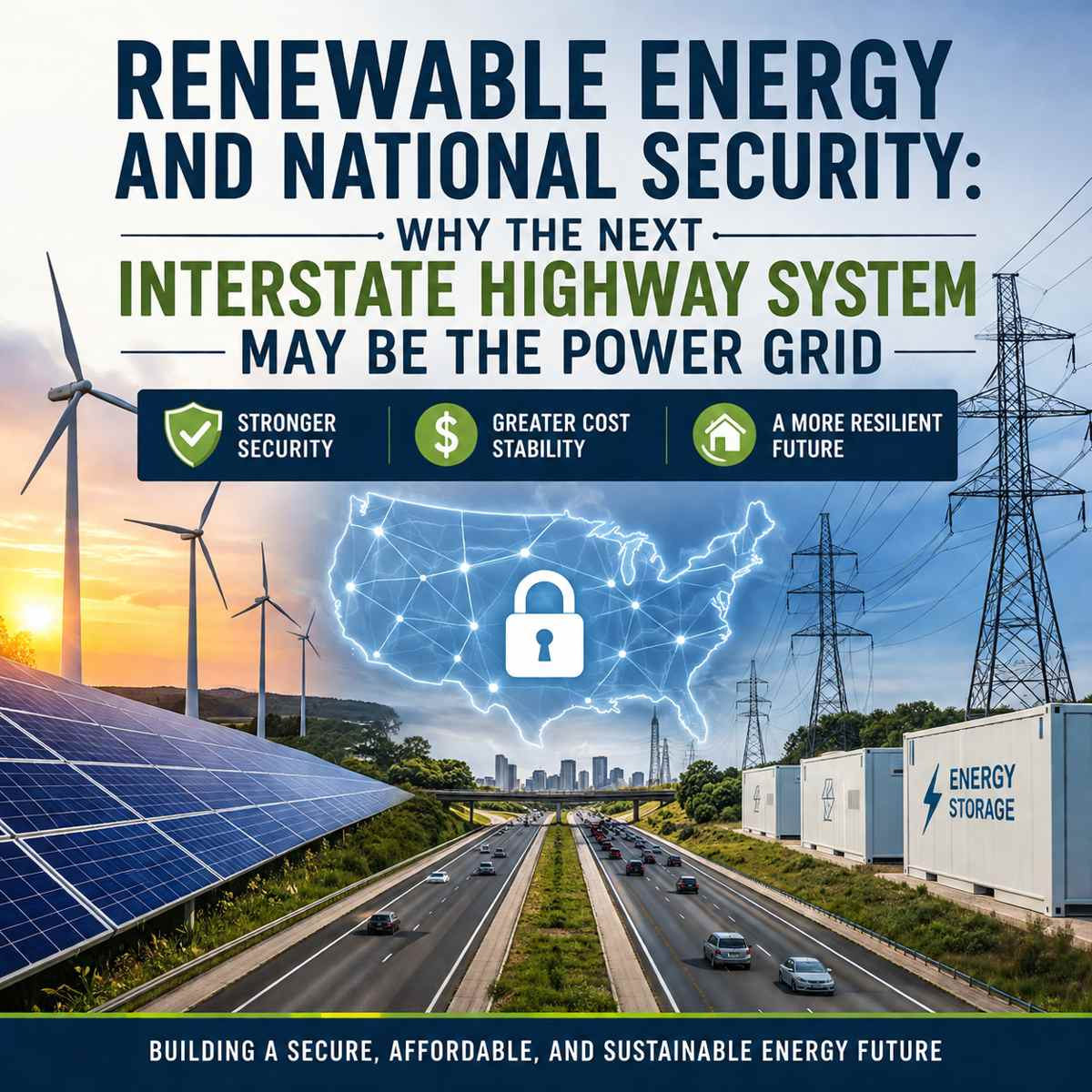
Renewable energy is increasingly viewed as a national security priority—not just an environmental goal—because it reduces dependence on foreign energy sources, stabilizes long-term costs, and protects households from global supply shocks. A coordinated national investment—similar to the Interstate Highway System—could strengthen economic resilience and improve financial stability for individuals and businesses.
📘 Introduction — Energy Is More Than a Utility Bill
Energy is often discussed in terms of environmental impact or monthly utility costs. That perspective is incomplete.
At its core, energy is both:
- A national security issue
- A primary driver of cost of living
Historically, access to energy has influenced global conflict, shaped alliances, and driven economic policy. Today, that dynamic still exists—but with an added layer of complexity. Modern economies remain deeply tied to global energy markets, meaning disruptions anywhere in the world can quickly affect prices at home.
This creates a structural vulnerability:
- When supply chains are disrupted, prices rise
- When geopolitical tensions escalate, energy becomes leverage
- When volatility increases, households absorb the cost
The central question is no longer whether energy matters—it’s whether the current system is resilient enough.
The United States may need a coordinated, large-scale energy infrastructure strategy—similar in ambition and scope to the Interstate Highway System—to improve long-term stability, security, and economic resilience.
⚔️ Section 1: The Link Between Energy and Global Conflict
Energy has long been intertwined with global power dynamics. Control over resources—particularly oil and natural gas—has shaped geopolitical tensions for decades.
Key Points
- Energy resources influence:
- Military strategy
- Foreign policy decisions
- Economic alliances
- Major conflicts have had clear energy dimensions, including:
- The Gulf War, where oil supply security played a central role
- The Russia–Ukraine War, where natural gas and energy exports have been used as strategic leverage
- Energy supply disruptions create ripple effects:
- Economic instability through disrupted trade and production
- Inflation as energy costs feed into transportation and manufacturing
- Political leverage, where energy-exporting nations gain influence over dependent economies
The key takeaway is straightforward:
Energy dependence creates strategic vulnerability.
⛽ Section 2: How Energy Volatility Impacts Household Finances
While energy conflicts occur at the global level, their impact is felt most directly at the household level.
Key Points
Energy costs influence nearly every part of daily life:
- Transportation
- Gasoline prices directly affect commuting and travel costs
- Food prices
- Higher fuel costs increase transportation expenses
- Fertilizer and production costs are tied to energy markets
- Utility bills
- Electricity and heating costs fluctuate with energy supply and demand
Volatility Creates Financial Pressure
When energy prices are unstable, households face:
- Budget uncertainty
- Reduced ability to plan long-term expenses
- Increased financial stress, particularly for fixed-income households
📊 Energy Shock → Household Impact (Snippet Table)
| Energy Event | Household Impact |
|---|---|
| Oil price spike | Higher gas prices |
| Supply disruption | Increased grocery costs |
| Utility price surge | Higher monthly bills |
Why This Matters for Financial Planning
Energy volatility is not just an inconvenience—it is a systemic risk to household stability.
For individuals and families trying to:
- Build a budget
- Save consistently
- Plan long-term
Unpredictable energy costs introduce a variable that is difficult to control.
🧭 The Bigger Picture
If energy volatility creates instability—and global dependence increases that volatility—then the logical next question becomes:
What would a more stable system look like?
That’s where renewable energy and infrastructure strategy begin to shift from environmental discussion to economic and national security policy.
🔌 Section 3: Why Renewable Energy Changes the Equation
The current energy system is deeply tied to global fuel markets, which introduces volatility, geopolitical risk, and cost uncertainty. Renewable energy begins to shift that framework in a meaningful way.
Key Points
Renewable energy is:
- Locally produced
- Solar and wind generation can be built domestically, closer to where energy is consumed
- Less tied to global markets
- Unlike oil and gas, renewable energy does not rely on continuous fuel imports subject to global price swings
A Fundamental Shift in Risk
Traditional energy systems expose economies to:
- Foreign supply disruptions
- Geopolitical conflict
- Commodity price volatility
Renewable energy shifts that risk profile:
- From geopolitical → to infrastructure-based risk
- The focus moves from “Where does the fuel come from?”
- To “How resilient is the system delivering power?”
This is a critical distinction. Infrastructure risks—while still important—are generally more controllable through domestic policy, investment, and planning.
Long-Term Benefits
- Cost predictability
- Renewable systems have higher upfront costs but minimal ongoing fuel expenses
- This creates more stable pricing over time
- Energy independence
- Reduced reliance on foreign energy sources
- Lower exposure to global supply shocks and political leverage
Why This Matters
From both a national security and financial planning perspective, renewable energy represents a shift toward:
- Greater stability
- More control over domestic outcomes
- Reduced exposure to external shocks
🧱 Section 4: The Interstate Highway System Analogy
To understand what a large-scale energy transition could look like, it helps to look at a historical precedent.
Key Points
The Interstate Highway System was:
- A national defense initiative
- Designed to improve military mobility and emergency response
- A coordinated federal effort
- Planned and executed at a national level with long-term vision
It Transformed the Country
The system reshaped the United States in several key ways:
- Commerce
- Enabled efficient movement of goods across regions
- Mobility
- Connected cities, suburbs, and rural areas
- Economic growth
- Supported expansion of industries and labor markets
Transition: A Modern Parallel
Today, the challenge is not transportation—it is energy.
Just as the highway system enabled physical movement:
- A modern energy system would enable reliable, efficient movement of electricity
The emerging idea:
The next major infrastructure system may not be roads—but a modernized, resilient energy grid designed for stability and security.
⚙️ Section 5: What a “Modern Energy System” Could Look Like
If the goal is to reduce volatility, improve resilience, and strengthen national security, the solution is not just more energy production—it is better infrastructure.
Key Components
A modern energy system would likely include:
- Nationwide transmission expansion
- High-capacity lines to move electricity across regions
- Reduces bottlenecks and improves efficiency
- Grid-scale energy storage
- Batteries and other storage technologies to balance supply and demand
- Helps manage intermittent energy sources like solar and wind
- Regional energy balancing
- Ability to shift energy where it is needed most
- Reduces the impact of localized shortages or disruptions
- Integration of diverse energy sources
- Solar for distributed generation
- Wind for large-scale renewable supply
- (Optional consideration) Nuclear for consistent, baseline power stability
📊 Traditional Grid vs Modern Energy System
| Feature | Traditional Grid | Modern Energy System |
|---|---|---|
| Energy Source | Centralized fossil fuels | Distributed + renewable |
| Pricing | Volatile | More stable |
| Risk Exposure | Global markets | Domestic infrastructure |
Strategic Takeaway
A modern energy system is not just about producing cleaner energy—it is about:
- Reducing exposure to global instability
- Creating predictable cost structures
- Building a more resilient economic foundation
From a financial planning perspective, this shift has long-term implications for:
- Cost of living
- Budget stability
- Economic resilience at both the household and national level
🪖 Section 6: National Security Benefits of Energy Independence
Energy independence is often framed as an economic goal, but its implications extend directly into national security. A system that relies less on foreign energy sources reduces vulnerability and strengthens long-term stability.
Key Points
- Reduced reliance on foreign energy suppliers
- Limits exposure to supply disruptions from unstable regions
- Reduces dependence on countries that may use energy as political leverage
- Lower exposure to geopolitical conflict
- Domestic energy production decreases the impact of overseas instability
- Lessens the economic fallout from global tensions, sanctions, or trade disruptions
- Improved grid resilience
- A modernized, distributed energy system can better withstand:
- Cyber threats, which increasingly target critical infrastructure
- Physical disruptions, including extreme weather, natural disasters, or targeted attacks
- A modernized, distributed energy system can better withstand:
Strategic Perspective
A more independent and resilient energy system shifts the United States from:
- Reactive (responding to global disruptions)
- To proactive (controlling domestic energy outcomes)
This transition strengthens both national defense capabilities and economic stability at home.
💸 Section 7: Cost Stability vs Price Volatility – A Financial Planning Perspective
From a financial planning perspective, energy is not just a macroeconomic issue—it is a recurring expense that directly impacts household budgets.
Key Points
- Fossil fuels
- Subject to global shocks such as:
- Supply disruptions
- Geopolitical conflict
- Market speculation
- Prices can change rapidly, creating uncertainty
- Subject to global shocks such as:
- Renewable energy
- Typically involves:
- Higher upfront infrastructure costs
- Lower ongoing (marginal) costs once operational
- Pricing tends to be more predictable over time
- Typically involves:
📊 Volatility Comparison
| Energy Type | Cost Structure | Risk Level |
|---|---|---|
| Oil/Gas | Ongoing + volatile | High |
| Renewables | Upfront + stable | Lower |
Why This Matters for Financial Planning
Stable energy costs contribute to:
- More predictable monthly budgets
- Improved long-term financial planning
- Reduced exposure to inflationary spikes tied to energy
For households, this connects directly to:
- Budgeting consistency
- Cost-of-living management
- Long-term financial resilience
Internal Linking Opportunities
- Budgeting frameworks (tracking fixed vs variable expenses)
- Inflation protection strategies (managing rising costs over time)
🏗️ Section 8: Why the U.S. Hasn’t Built This Yet
Despite the potential benefits, the transition to a modern, large-scale energy system has been slow. The challenge is not just technological—it is structural.
Key Barriers
- Permitting delays
- Infrastructure projects often require extensive regulatory approval
- Multi-year timelines can delay or prevent development
- Political fragmentation
- Energy policy is shaped at federal, state, and local levels
- Conflicting priorities can stall coordinated efforts
- Local opposition (NIMBY — “Not In My Backyard”)
- Resistance to new infrastructure such as transmission lines or wind farms
- Local concerns can override broader national objectives
- Short-term policy cycles
- Political timelines often focus on near-term outcomes
- Large infrastructure projects require long-term commitment and consistency
Structural Insight
Unlike the coordinated effort behind the Interstate Highway System, today’s energy transition faces a more complex environment:
- More stakeholders
- More regulatory layers
- Less centralized execution
Bottom Line
The challenge is not whether the United States can build a modern energy system—it is whether it can align policy, incentives, and long-term vision to do so effectively.
🌍 Section 9: Global Competition and Strategic Risk
Energy is no longer just a domestic policy issue—it is part of a broader global competition that will shape economic leadership for decades.
Key Points
- Other countries are investing heavily in:
- Renewable infrastructure
- Large-scale solar and wind deployment
- National grid modernization efforts
- Energy storage
- Battery technology and grid-scale storage systems
- Supply chain control over critical materials
- Renewable infrastructure
Strategic Risk
- Losing competitive advantage
- Countries that build stable, low-cost energy systems gain:
- Lower production costs
- Stronger industrial competitiveness
- Greater economic resilience
- Countries that build stable, low-cost energy systems gain:
- Increased long-term costs
- Delayed investment can lead to:
- Higher future infrastructure costs
- Continued exposure to volatile global energy markets
- Reduced ability to compete in energy-intensive industries
- Delayed investment can lead to:
Bigger Picture
Energy strategy is increasingly tied to:
- Economic growth
- Industrial policy
- National security positioning
Nations that move early toward stable, scalable energy systems are better positioned to:
- Attract investment
- Support domestic manufacturing
- Maintain long-term cost advantages
🧠 Section 10: What This Means for Your Financial Plan
While energy policy operates at the national level, its effects are felt most directly in household finances.
Key Takeaways
- Energy stability affects:
- Monthly budgets
- Utility bills and transportation costs are recurring expenses
- Long-term cost planning
- Energy prices influence inflation and overall cost of living
- Monthly budgets
What Households Should Expect
- Continued volatility in traditional energy markets
- Prices may fluctuate due to global supply and geopolitical events
- Greater importance of monitoring energy costs
- Energy should be treated as a core budget category—not a fixed assumption
Practical Financial Planning Insight
To manage energy-related risk, households can:
- Track energy expenses alongside other variable costs
- Build flexibility into monthly budgets
- Account for potential cost increases in long-term planning
Internal Linking Opportunities
- Financial planning roadmap (building a comprehensive plan that accounts for variable expenses)
- Expense tracking guide (monitoring recurring and fluctuating costs effectively)
Bottom Line
Energy is not just a background expense—it is a foundational input into your financial life.
Understanding how energy markets work—and how they may evolve—can help you:
- Build more resilient budgets
- Prepare for cost fluctuations
- Make more informed long-term financial decisions
❓ FAQ Section (SEO + Featured Snippets)
Is renewable energy cheaper long-term?
Often, yes. Renewable energy systems typically have higher upfront costs but much lower ongoing operating expenses because they do not rely on fuel inputs. Over time, this can lead to greater price stability and lower total costs compared to energy sources that are subject to global price fluctuations.
Does renewable energy improve national security?
Yes. Renewable energy reduces dependence on foreign energy sources, which lowers exposure to geopolitical conflict and supply disruptions. A more domestically driven energy system can enhance stability and reduce the strategic risks associated with global energy markets.
Why hasn’t the U.S. fully transitioned yet?
The transition has been slowed by a combination of infrastructure limitations, policy fragmentation, and regulatory challenges. Large-scale energy systems require long-term planning, coordinated investment, and streamlined permitting—factors that are often difficult to align across multiple levels of government and stakeholders.
🧭 Conclusion — The Next National Infrastructure Moment
Energy is not just a utility expense—it is a foundational component of economic stability.
From household budgets to national security, the reliability and cost of energy influence nearly every aspect of financial life. As global markets remain volatile and geopolitical tensions persist, the need for a more stable and resilient energy system becomes increasingly clear.
The Interstate Highway System offers a powerful analogy. It was a coordinated, forward-looking investment that reshaped the economy, improved mobility, and strengthened national defense.
Today, the next major infrastructure opportunity may not be physical roads—but energy itself.
A modern, resilient energy grid has the potential to:
- Reduce economic volatility
- Strengthen national security
- Provide long-term cost stability for households and businesses
📣 Call to Action
Energy costs are not just background expenses—they are a critical part of your financial plan.
Consider taking the following steps:
- Review your energy costs
- Evaluate how much you spend monthly on utilities and transportation
- Identify trends or seasonal spikes
- Incorporate energy into your budgeting process
- Treat energy as a variable expense that may fluctuate over time
- Build flexibility into your financial plan
- Explore related financial planning resources
- Learn how inflation impacts your purchasing power
- Strengthen your budgeting approach to handle cost volatility
Suggested Next Reads
- Inflation and cost-of-living guides
- Budgeting frameworks and expense tracking strategies
Final Thought
The transition in energy is not just about technology—it is about stability.
And for households focused on long-term financial health, stability is one of the most valuable assets you can build.
Back to Policy & Household Finances