🎯 Introduction
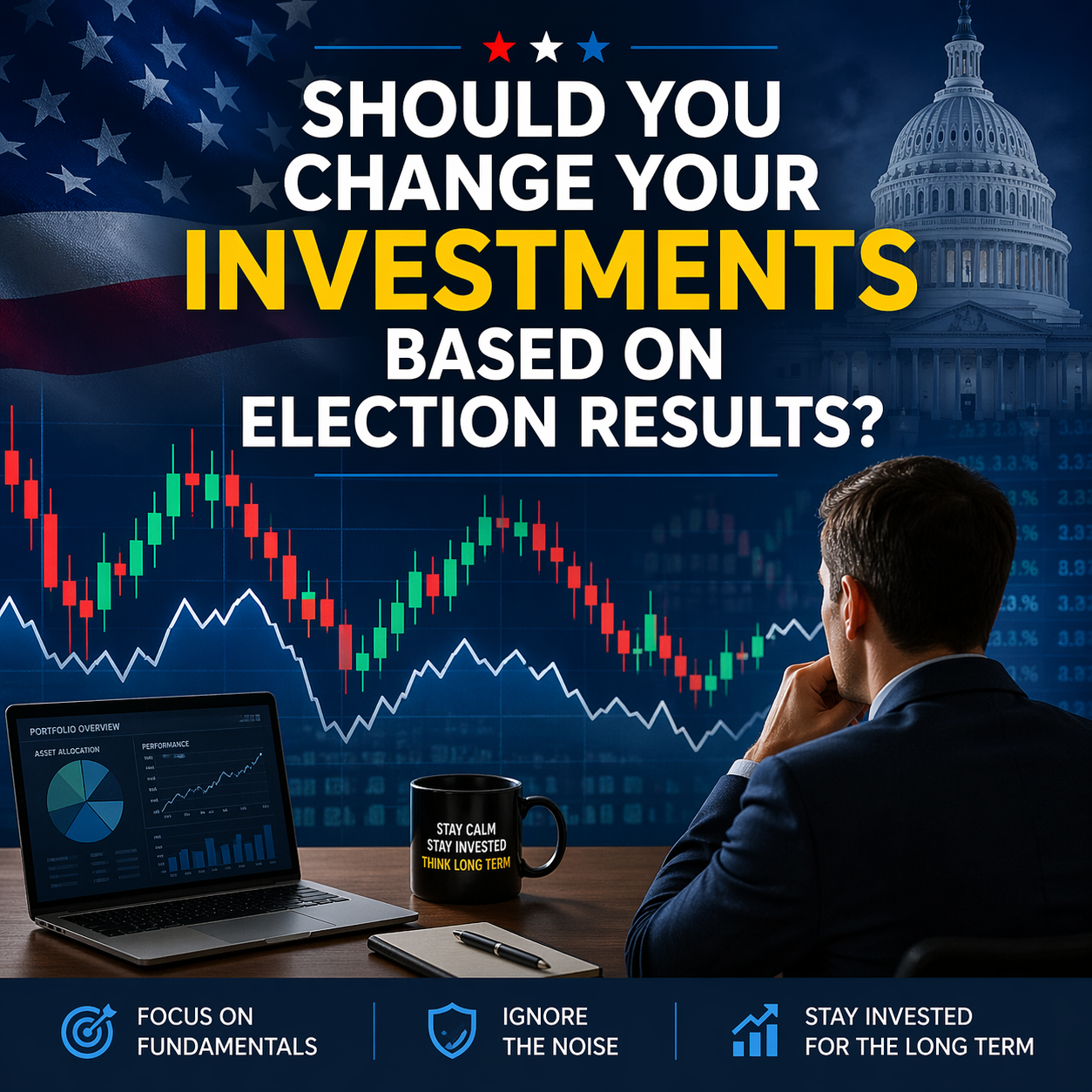
“Every election cycle, investors ask the same question: Should I change my portfolio based on who wins?”
It’s a natural reaction. Elections bring uncertainty—and uncertainty creates fear. You hear about potential market crashes, sweeping policy changes, and tax shifts that could impact your investments overnight. Headlines amplify the noise, and suddenly it feels like sitting still might be the riskiest move of all.
But here’s the reality: reacting emotionally to elections is one of the most common—and costly—mistakes investors make.
In this guide, we’ll break down what actually happens to markets after elections—and what smart investors do instead.
📘 What You’ll Learn in This Guide
- Whether elections actually impact the stock market
- What history shows about investing during political shifts
- The biggest mistakes investors make during election cycles
- A simple, practical framework to guide your investment decisions
⚡ Quick Answer — Should You Change Your Investments?
Most investors should NOT change their investment strategy based on election results alone. Long-term market performance is driven by economic fundamentals—not political outcomes.
🧠 Why This Matters
Markets are forward-looking and complex. While elections can create short-term volatility, they rarely alter the long-term trajectory of diversified investments.
What actually drives returns over time?
- Corporate earnings growth
- Interest rates and monetary policy
- Economic expansion and productivity
Political outcomes may influence these factors at the margins—but they are not the primary engine of market performance.
📊 A Reality Check for Investors
If you’re considering making changes to your portfolio based solely on an election result, it’s worth asking:
- Has your financial goal changed?
- Has your time horizon shifted?
- Has your risk tolerance fundamentally changed?
If the answer is no, then your investment strategy likely shouldn’t change either.
🧭 The Core Principle
You don’t build a portfolio for the next election—you build it for the next 10, 20, or 30 years.
📊 Do Elections Actually Affect the Stock Market?
🔹 Short-Term vs Long-Term Impact
One of the biggest misconceptions investors have is confusing short-term market reactions with long-term investment outcomes.
📉 Short-Term Impact: Noise and Volatility
In the weeks and months surrounding an election, markets can become more volatile. This is driven by:
- Uncertainty about policy direction
- Investor sentiment reacting to polls and headlines
- Media amplification of worst-case scenarios
You’ll often see:
- Sudden market swings
- Sector-specific reactions (e.g., healthcare, energy, defense)
- Increased trading volume
👉 Key takeaway:
In the short term, markets react to expectations and headlines, not fundamentals.
📈 Long-Term Impact: Fundamentals Win
Over longer time horizons, election outcomes fade in importance. What ultimately drives market performance are:
- Corporate earnings growth
- Interest rates and Federal Reserve policy
- Economic expansion and productivity
These forces operate independently of any single election cycle.
👉 Key takeaway:
In the long run, markets follow economic reality—not political cycles.
🔹 Historical Market Performance After Elections
History provides a useful lens for cutting through the noise.
| Scenario | Typical Market Reaction |
|---|---|
| Election uncertainty | Increased volatility |
| Post-election clarity | Often positive market performance |
| Divided government | Stable, market-friendly environment |
This pattern has repeated across multiple election cycles, regardless of which party wins.
🔹 Why Markets Often Rise After Elections
At first glance, it may seem counterintuitive that markets often perform well after elections—especially when political tensions are high.
But there are clear reasons behind this pattern:
🧠 Uncertainty Is Removed
Markets dislike uncertainty more than almost anything else. Once election results are finalized:
- Unknown outcomes become known
- Risk is easier to price
- Investors regain confidence
⚖️ Policy Expectations Stabilize
Even if investors don’t like the outcome, they now understand:
- Likely tax direction
- Regulatory priorities
- Legislative constraints
👉 This clarity allows businesses and investors to plan more effectively.
🏢 Businesses Regain Confidence
Companies make long-term decisions based on predictability.
After elections:
- Capital spending decisions become clearer
- Hiring plans stabilize
- Strategic investments resume
🧭 The Bigger Insight
Markets don’t need perfect political outcomes—they need predictable environments.
That’s why, time and time again, the period **after elections—not before—tends to be more supportive for investors.
🔎 What This Means for You
If you’re reacting to election headlines:
- You’re likely responding to short-term volatility
- Not the long-term drivers of returns
Understanding this distinction is one of the most powerful advantages an investor can have.
⚖️ Politics vs Markets — What Actually Drives Returns?
🔹 The 3 Real Market Drivers
While politics dominates headlines, it’s not the primary force behind long-term market performance. To understand how your investments actually grow over time, you need to focus on the core drivers that consistently shape returns.
📈 1. Corporate Earnings
At its core, the stock market reflects the value of businesses.
- When companies grow profits → stock prices tend to rise
- When earnings decline → stock prices often follow
Earnings are influenced by:
- Consumer demand
- Innovation and productivity
- Cost management
👉 Key takeaway:
Over time, profits—not politics—drive stock prices.
💰 2. Interest Rates (Federal Reserve Policy)
Interest rates affect nearly every part of the financial system.
- Lower rates:
- Encourage borrowing and investment
- Support higher stock valuations
- Higher rates:
- Increase borrowing costs
- Put pressure on stock prices
These decisions are primarily guided by the Federal Reserve, not election outcomes.
👉 Key takeaway:
Interest rate policy often has a greater impact on markets than political leadership changes.
📊 3. Economic Growth
A growing economy supports:
- Higher corporate revenues
- Job creation
- Increased consumer spending
Key indicators include:
- GDP growth
- Employment trends
- Productivity gains
👉 Key takeaway:
Strong economies tend to produce strong markets, regardless of political control.
🧠 The Core Principle
“You don’t invest in politics—you invest in businesses.”
This mindset helps filter out noise and refocus your strategy on what truly matters.
🔹 Why Politics Gets Overweighted
If fundamentals matter more, why do so many investors fixate on elections?
📺 Media Amplification
Political events generate attention—and attention drives clicks.
- Headlines emphasize risk and conflict
- Worst-case scenarios are highlighted
- Constant coverage creates a sense of urgency
👉 Result: Investors feel like action is required, even when it isn’t.
😰 Emotional Reactions
Money is personal, and politics can be emotional.
- Investors may:
- Fear policy changes
- React based on personal beliefs
- Seek to “protect” their portfolio
👉 This often leads to:
- Overtrading
- Poor timing decisions
🔁 Recency Bias
Investors tend to overweight what just happened.
- A recent election result feels highly important
- Short-term market reactions feel like long-term trends
👉 But history shows:
- Markets adapt quickly
- Long-term trends reassert themselves
🧭 The Bigger Insight
Politics can influence markets at the margins—but it is rarely the primary driver of long-term returns.
Investors who focus on fundamentals tend to outperform those who react to headlines.
🔎 What This Means for You
Before making a portfolio decision based on politics, ask:
- Is this driven by data or emotion?
- Does this affect earnings, rates, or growth?
If not, it’s likely noise—not a signal.
🧠 Investing vs Trading — Why This Distinction Matters During Elections
One of the biggest reasons investors struggle during election cycles is simple:
They confuse investing with trading.
When uncertainty rises, many people shift—often unintentionally—from a long-term investment mindset to short-term reaction mode. Understanding the difference is critical if you want to make better decisions during volatile, headline-driven periods.
🔹 What Fundamental Investing Actually Means
Fundamental investing is built on a straightforward principle:
You are buying ownership in real businesses—not reacting to short-term events.
Long-term investors focus on:
- Company earnings and profitability
- Competitive advantages (moats)
- Long-term growth potential
- Broader economic trends
They ask questions like:
- Will this company be stronger in 5–10 years?
- Is this business generating sustainable value?
They are not asking:
- What will happen to the market next week if this candidate wins?
👉 Key takeaway:
Fundamental investing is about value over time—not timing the moment.
🔹 What Trading Looks Like (And Why Elections Trigger It)
Trading operates on a completely different mindset.
It focuses on:
- Short-term price movements
- News events and sentiment
- Market timing and positioning
During election cycles, this mindset becomes more common:
- Selling based on fear of a negative outcome
- Buying based on expected policy changes
- Reacting quickly to headlines and polling shifts
👉 The problem:
Most investors are not professional traders—but election environments push them to behave like one.
🔹 Why Election Reactions Are Usually Trading—Not Investing
If you’re changing your portfolio based on election results, consider what’s actually happening:
- You’re making a short-term decision
- Based on uncertain and unpredictable outcomes
- Without any change in the underlying value of the businesses you own
That’s not long-term investing.
👉 That’s trading based on speculation.
🔹 The Breakwater Perspective
At Breakwater Path, the goal is not to predict political outcomes.
It’s to build a portfolio that can withstand uncertainty—regardless of the environment.
That means:
- Staying diversified
- Aligning investments with long-term goals
- Avoiding reactionary decisions driven by noise
- Understanding valuations of individual securities
🧭 The Key Distinction
| Approach | Focus | Behavior During Elections |
|---|---|---|
| Investing | Long-term value | Stay disciplined and hold |
| Trading | Short-term price | React to headlines and events |
🔎 What This Means for You
Before making a move during an election cycle, pause and ask:
- Am I acting like an investor?
- Or reacting like a trader?
That single question can help you avoid some of the most common—and costly—mistakes investors make.
⚠️ Breakwater Insight
If your strategy changes based on elections, it’s not a strategy—it’s a reaction.
🚨 The Biggest Investing Mistakes During Election Cycles
Election seasons create the perfect environment for poor investment decisions. Uncertainty rises, headlines dominate, and emotions run high. That combination often leads investors to take actions that feel right in the moment—but hurt long-term performance.
🔹 Mistake #1 — Trying to Time the Market
One of the most common reactions during elections is the urge to “get ahead” of potential outcomes.
This often shows up as:
- Selling before elections to avoid a potential downturn
- Waiting “until things settle” before reinvesting
The problem?
Markets are forward-looking and unpredictable in the short term. By the time uncertainty “settles,” prices have often already moved.
👉 Key takeaway:
Timing the market requires being right twice—when you sell and when you buy back in.
🔹 Mistake #2 — Letting Politics Drive Financial Decisions
It’s easy to let personal beliefs influence investment choices—especially during emotionally charged election cycles.
This often leads to:
- Confirmation bias
- Seeking information that supports your political or market view
- Emotional investing
- Making decisions based on fear, frustration, or optimism
The danger is that these decisions are rarely grounded in financial fundamentals.
👉 Key takeaway:
Your portfolio should reflect your financial goals, not your political opinions.
🔹 Mistake #3 — Overreacting to Headlines
Election cycles produce a constant stream of breaking news, predictions, and analysis.
The issue:
- Most headlines focus on short-term developments
- Markets respond quickly—but also move on quickly
Reacting to every update can lead to:
- Frequent trading
- Poor entry and exit timing
- Increased transaction costs
👉 Key takeaway:
Short-term news rarely changes long-term investment outcomes.
📉 What Happens If You Actually Change Your Portfolio?
Understanding the consequences of these mistakes is critical. Even well-intentioned moves can lead to missed opportunities and reduced returns.
🔹 Example Scenario
Let’s walk through a simple, realistic scenario:
- An investor becomes concerned about election uncertainty
- They sell their investments before the election to “play it safe”
- The market experiences volatility—but then rallies after results are known
- The investor waits for stability and eventually buys back in at higher prices
Result:
- They avoided short-term volatility
- But missed the recovery and locked in lower returns
👉 This pattern happens more often than most investors realize.
🔹 The Cost of Being Wrong
Even small timing mistakes can have a significant impact over time.
| Action | Risk |
|---|---|
| Selling early | Missing potential gains |
| Holding cash | Losing purchasing power to inflation |
| Reacting late | Buying back at higher prices |
🧭 The Bigger Insight
The biggest risk during election cycles isn’t market volatility—it’s investor behavior.
Staying disciplined during uncertain times is often the difference between long-term success and underperformance.
🔎 What This Means for You
Before making a move during an election cycle, pause and ask:
- Am I reacting to fear or fundamentals?
- Does this decision align with my long-term plan?
If the answer isn’t clear, the best move is often the simplest one:
👉 Stay invested and stay disciplined.
🧠 A Smarter Framework for Election
This is where disciplined investors separate themselves from reactive ones.
Instead of trying to predict election outcomes or market reactions, the goal is to follow a repeatable framework that works in any political environment.
🔹 Step 1 — Stick to Your Financial Plan
Your investment strategy should be built around:
- Your goals
- Your timeline
- Your risk tolerance
Not election cycles.
If you’ve already built a structured plan, that becomes your anchor during periods of uncertainty.
👉 Internal link:
- Financial Planning Roadmap
👉 Key takeaway:
A well-built financial plan should already account for uncertainty—including elections.
🔹 Step 2 — Focus on Time Horizon
One of the most powerful filters in investing is your time horizon.
- Short-term goals (0–3 years):
- Stability matters more
- Lower exposure to market volatility
- Long-term goals (10+ years):
- Market fluctuations are expected
- Growth becomes the priority
Elections are short-term events. Most investment goals are long-term.
👉 Key takeaway:
Don’t let short-term events disrupt long-term strategies.
🔹 Step 3 — Rebalance, Don’t React
Instead of making emotional decisions, focus on maintaining your target allocation.
Rebalancing involves:
- Trimming assets that have grown beyond your target
- Adding to areas that have lagged
This keeps your portfolio aligned with your risk profile—without trying to predict the market.
👉 Example:
- Stocks outperform → trim slightly
- Bonds underperform → add selectively
👉 Key takeaway:
Rebalancing is disciplined. Reacting is emotional.
🔹 Step 4 — Ignore Noise, Watch Fundamentals
Markets move on data—not headlines.
Focus on the indicators that actually matter:
- Inflation — impacts purchasing power and interest rates
- Interest rates — influence borrowing, spending, and valuations
- Corporate earnings — drive long-term stock performance
👉 Key takeaway:
Fundamentals shape long-term returns—noise creates short-term distraction.
🧭 The Framework in One Sentence
Stay disciplined, stay diversified, and stay focused on what actually drives returns.
🧠 A Framework for Election-Year Investing
This is where disciplined investors separate themselves from reactive ones.
Instead of trying to predict election outcomes or market reactions, the goal is to follow a repeatable framework that works in any political environment.
At the center of that framework is something most investors overlook—but professionals rely on:
A clearly defined Investment Policy Statement (IPS).
📄 🔹 Step 1 — Anchor Your Strategy With an Investment Policy Statement (IPS)
An Investment Policy Statement is a written document that defines:
- Your financial goals
- Your time horizon
- Your risk tolerance
- Your target asset allocation
- Rules for when—and why—you make changes
It answers the question:
“What should I do when markets—and emotions—become unpredictable?”
During election cycles, this becomes your decision-making filter.
Instead of reacting to headlines, you follow a pre-defined strategy.
🧠 What an IPS Prevents
A well-constructed IPS protects you from:
- Emotional decision-making
- Market timing mistakes
- Reactionary portfolio changes
- Politically driven investing
👉 Key takeaway:
Your IPS makes decisions before emotions have a chance to interfere.
🧭 Example IPS Rule
- “I will not change my asset allocation based on political events or election outcomes.”
- “I will rebalance my portfolio annually or when allocations drift by more than 5%.”
👉 These simple rules can prevent costly mistakes.
🔹 Step 2 — Focus on Time Horizon
One of the most powerful filters in investing is your time horizon.
- Short-term goals (0–3 years):
- Stability matters more
- Lower exposure to market volatility
- Long-term goals (10+ years):
- Market fluctuations are expected
- Growth becomes the priority
Elections are short-term events. Most investment goals are long-term.
👉 Key takeaway:
Don’t let short-term events disrupt long-term strategies.
🔹 Step 3 — Rebalance, Don’t React
Instead of making emotional decisions, focus on maintaining your target allocation.
Rebalancing involves:
- Trimming assets that have grown beyond your target
- Adding to areas that have lagged
This keeps your portfolio aligned with your risk profile—without trying to predict the market.
👉 Example:
- Stocks outperform → trim slightly
- Bonds underperform → add selectively
👉 Key takeaway:
Rebalancing is disciplined. Reacting is emotional.
🔹 Step 4 — Ignore Noise, Watch Fundamentals
Markets move on data—not headlines.
Focus on the indicators that actually matter:
- Inflation — impacts purchasing power and interest rates
- Interest rates — influence borrowing, spending, and valuations
- Corporate earnings — drive long-term stock performance
👉 Key takeaway:
Fundamentals shape long-term returns—noise creates short-term distraction.
🧭 The Framework in One Sentence
Stay disciplined, follow your Investment Policy Statement, and focus on what actually drives long-term returns.
🔎 Breakwater Insight
The best investors don’t make decisions during elections—they follow rules they created before the uncertainty began.
📊 When Should You Actually Adjust Your Investments?
This is where nuance matters.
While elections alone are not a valid reason to change your portfolio, there are legitimate situations where adjustments make sense.
🔹 Legitimate Reasons to Adjust
These are grounded in your personal financial situation—not external events.
👤 Life Changes
- Marriage or divorce
- Having children
- Career transitions
⚖️ Risk Tolerance Shift
- You become more conservative or more aggressive
- Your comfort with volatility changes
⏳ Time Horizon Changes
- Approaching retirement
- Major financial goals getting closer
👉 Key takeaway:
Portfolio changes should reflect your life—not the news cycle.
🔹 NOT Legitimate Reasons
These are the most common—but least reliable—reasons investors make changes.
🗳️ Election Results
- Markets have performed under all political environments
- Outcomes are often already priced in
🧠 Political Opinions
- Personal beliefs don’t translate into predictable market outcomes
📰 News Cycles
- Headlines are designed for attention—not long-term investment strategy
⚠️ The Critical Distinction
There’s a difference between reacting to events and responding to real changes in your financial life.
Understanding that distinction helps you avoid costly mistakes.
🔎 What This Means for You
Before making any investment change, ask:
- Is this based on my financial plan?
- Or am I reacting to external noise?
If it’s the latter, the best course of action is often the simplest:
👉 Stay disciplined, stay invested, and stay focused on the long term.
🚀 Continue Learning
- Market Cycles Explained
Understand how markets move through expansion, contraction, and recovery—and what that means for your investments. - How to Manage Risk in Your Portfolio
Discover strategies to protect your investments while still pursuing long-term growth. - Long-Term Investing Strategies
Explore proven approaches that prioritize consistency, discipline, and compounding over time.
❓ Frequently Asked Questions
🔹 Should I sell stocks before an election?
In most cases, no. Selling before an election is an attempt to time the market, which is extremely difficult to do consistently. Markets often move unpredictably, and you risk missing potential gains if the market rises after the election.
🔹 Is the stock market better under Democrats or Republicans?
Historical data shows that markets have performed under both parties. Long-term returns are driven more by economic fundamentals—like earnings, interest rates, and growth—than by which party is in power.
🔹 Do elections cause market crashes?
Elections can create short-term volatility, but they are rarely the sole cause of market crashes. Major downturns are typically driven by economic factors such as recessions, financial crises, or systemic risks.
🔹 Should I wait until after the election to invest?
Waiting for “certainty” can be costly. By the time election outcomes are clear, markets may have already adjusted. Staying consistently invested is generally more effective than trying to time entry points.
🏁 Final Thought
Elections can feel significant—and they are—but when it comes to investing, their impact is often overstated.
“Elections may change headlines—but your financial future depends on discipline, not political outcomes.”
The most successful investors don’t chase the news. They follow a plan.
- ✔ Stick to their financial plan
- ✔ They stay invested through uncertainty
- ✔ The focus on long-term goals—not short-term noise
🔎 Closing Insight
Markets will always face uncertainty—elections are just one of many variables. What matters most is how you respond.
👉 Discipline, consistency, and a long-term mindset will outperform reactionary decisions—every time.
Back to Policy & Household Finances