Introduction
China’s electric-vehicle industry presents the United States with a question that is much bigger than cars.
In 2025, nearly 22 million electric cars were produced worldwide. China produced about 16 million of them and captured nearly three-quarters of global electric-car production. More than 13 million electric cars were sold in China, where EVs reached almost 55% of new-car sales. China also accounted for more than 80% of global battery-cell production, roughly 85% of cathode active material and more than 90% of anode active material used in EV batteries, according to the International Energy Agency’s Global EV Outlook 2026.
Those numbers should cause Americans to ask a difficult question: How did one country build such a commanding position in a major emerging industry while the United States remains locked in recurring political arguments over whether the industry should be encouraged at all?
The lesson is not that America should copy China’s political or economic system. China’s industrial strategy has produced real problems, including excess capacity, intense price competition, inefficient investment and companies that may never earn adequate returns on the capital invested in them.
But there is something worth learning from the underlying strategy: China established a destination and spent years building an ecosystem around it.
America once did this too.
The interstate highway system, the space program, federal support for basic research, defense procurement, early semiconductor development and DARPA all reflected a country willing to identify capabilities it considered important and invest for decades. Private companies then built enormous businesses on top of the technologies, infrastructure and knowledge that emerged.
Today, American economic debates too often begin and end with taxes, tariffs, interest rates and the next election. We talk about lowering prices and creating jobs, but much less frequently ask the larger question:
What do we want the American economy to be extraordinarily good at 30 years from now?
That may be the question we need to put back at the center of economic policy.
The False Choice Between Free Markets and Central Planning
The United States does not need to choose between laissez-faire capitalism and a centrally planned economy.
In reality, there has never been a completely unguided American market. Government influences where capital flows through tax policy, mortgage policy, infrastructure, defense procurement, research grants, patents, zoning, trade rules, education spending and regulation.
The 30-year mortgage itself exists within an enormous public-policy framework. Interstate highways changed where Americans lived and where businesses invested. Defense and space procurement helped create markets for technologies that were initially too expensive for ordinary consumers. Federal research funding has supported scientific work whose commercial payoff could be decades away.
So the relevant question isn’t whether government should influence markets. It already does.
The better question is:
What outcomes should those incentives encourage?
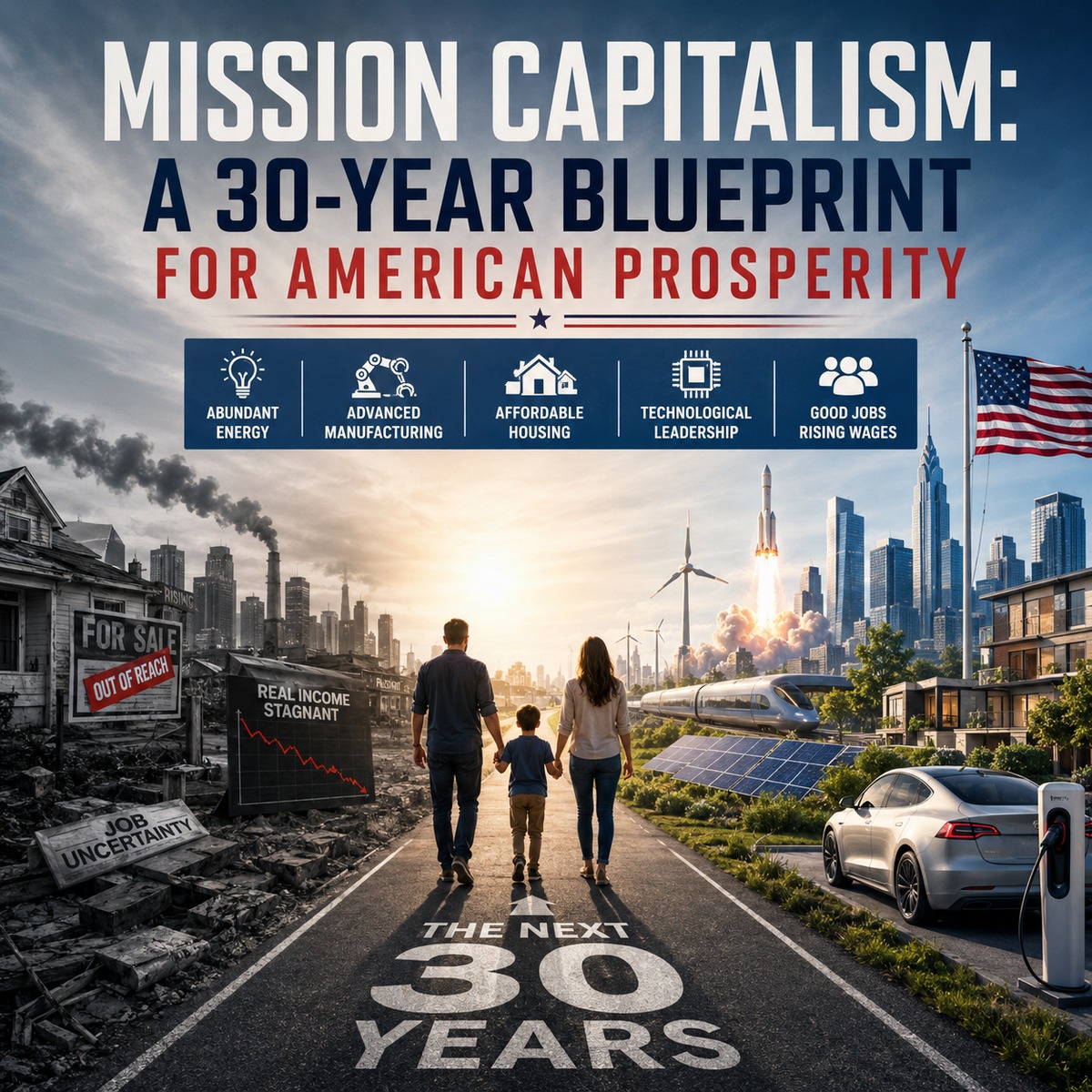
I would describe the model America needs as Mission Capitalism: government establishes a limited number of measurable, long-term national objectives, builds enabling infrastructure and shares early technological risk, while private businesses compete aggressively over how to accomplish those objectives.
The simplest formulation is this:
Government sets the destination. Competitive markets figure out the best route.
Mission Capitalism vs. Other Economic Models
| Economic Model | Government Sets Long-Term Goals | Markets Choose Winners | Government Supports Strategic Investment | Competition Remains Central |
|---|---|---|---|---|
| Laissez-Faire Capitalism | Limited | Yes | Limited | Yes |
| Central Planning | Yes | Limited | Yes | Limited |
| State Capitalism | Yes | Partially | Extensive | Partially |
| Mission Capitalism | Yes | Yes | Targeted | Yes |
Markets Are Powerful Optimization Engines—but They Need Goalposts
Markets are remarkably good at answering a particular question: Where can capital earn the best return given today’s risks, prices, regulations and incentives?
That is not necessarily the same as asking what industrial capabilities Americans will wish they possessed in 2040 or 2055.
Imagine a corporation deciding between buying back stock and making a risky multibillion-dollar investment in a new manufacturing technology. The buyback may produce the better risk-adjusted return for shareholders. A battery factory, advanced nuclear reactor, robotics facility or new transmission technology may require years of losses before reaching scale.
The company can make a completely rational decision while the country ends up with an undesirable long-term outcome.
This is especially important when investments have benefits that the original investor cannot fully capture. Basic research, worker training, infrastructure, new manufacturing ecosystems and early deployment of new technologies can create knowledge and capabilities that spill over into the rest of the economy.
That creates one of the central principles behind Mission Capitalism:
Markets optimize within the goalposts society gives them. Poorly designed goalposts can produce highly efficient versions of outcomes society never intended.
China’s EV Industry Shows What Long-Term Goalposts Can Do
China’s EV industry is an extraordinary example of industrial scale.
According to the IEA’s Global EV Outlook 2026, China produced approximately 16 million electric cars in 2025 and remained by far the world’s largest EV manufacturing hub. Production exceeded domestic demand by about 20%, helping push Chinese electric-car exports above 2.5 million vehicles. China also produced more than 80% of the world’s battery cells and even larger shares of important battery materials.
This did not happen because Chinese policymakers accurately predicted which individual company would win.
China created a large domestic market, encouraged battery and EV manufacturing, invested in charging and supporting infrastructure, developed supply chains and allowed intense competition among manufacturers.
There are important warnings embedded in the same story. China’s EV production exceeded domestic demand in 2025, and competition has squeezed manufacturer margins. Industrial policy can create too much capacity just as laissez-faire markets can create too little strategic investment.
America therefore should not copy China’s model. It should learn from its ability to maintain a technological direction long enough for companies, suppliers, workers and infrastructure to organize around it.
Consider the problem facing an American manufacturer contemplating a $5 billion factory with a useful life of perhaps 20 or 30 years. The investment decision becomes considerably harder when tax policy, trade policy, environmental rules and even the government’s basic view of the technology can reverse after an election.
A durable national strategy does not require one political party to control Congress for decades. In fact, it should be designed specifically so that it doesn’t. The most important national goals should be broad enough to survive changes in political leadership, with competition focused on how to achieve them rather than repeatedly reopening the question of whether America should pursue them at all.
America Already Has a Guided Economy—Housing Shows What Can Go Wrong
Housing demonstrates why the quality of the goalpost matters.
For decades, federal, state and local policies have encouraged homeownership and supported mortgage credit. At the same time, many high-demand communities have restricted the construction of additional housing through zoning, permitting requirements and other supply constraints. A 2025 NBER review concluded that housing-supply constraints have become increasingly binding, while other NBER research has found that restrictive land-use rules can raise prices, reduce construction and even weaken incentives for construction firms to invest in productivity-enhancing technology. The research is not unanimous about how much supply restrictions explain nationwide price growth, but the evidence is strong enough that housing abundance belongs near the center of any long-term affordability strategy.
Those policies can work against one another.
Subsidizing the ability to buy something while restricting the supply of that thing can increase its price. Existing homeowners benefit from appreciating property. Prospective homeowners face a progressively higher entry price.
America effectively developed an economic objective that often treats rising home prices as good news. For an existing homeowner, they frequently are. But affordable housing requires almost the opposite outcome: the supply of housing needs to grow enough that housing costs do not continually outrun household incomes.
That creates a fundamental conflict between viewing a house primarily as shelter and viewing it as an investment expected to appreciate faster than incomes.
Productive Wealth and Scarcity Wealth Are Not the Same Thing
Imagine that every house in America doubled in price tomorrow.
Measured household wealth would soar. Yet the country would not suddenly have twice as many houses, bedrooms or acres of residential land. America would have essentially the same stock of shelter at dramatically higher prices.
Existing owners would appear wealthier. First-time buyers would face a much larger financial hurdle.
This illustrates an important distinction between productive wealth and scarcity wealth.
Productive wealth expands what an economy can do: factories, businesses, power plants, technology, infrastructure, intellectual property and productive equipment.
Scarcity wealth can rise because access to an existing asset becomes more expensive. Constrained urban land and housing in severely supply-limited markets are obvious examples.
Both are legitimate forms of wealth to an individual owner, but they do not have the same implications for national prosperity.
If a new technology makes electricity 50% cheaper, society has gained a productive advantage. If a zoning restriction makes a particular parcel of land 50% more expensive, the owner has gained wealth, but society has not necessarily gained productive capacity.
For decades, America may have paid too much attention to whether existing assets became more valuable and too little attention to whether the economy became more capable of producing abundant essentials.
Productive Wealth vs. Scarcity Wealth
| Productive Wealth | Scarcity Wealth |
|---|---|
| New factories | Housing appreciation caused by constrained supply |
| Additional electricity generation | Rising land values caused by scarcity |
| New technology | Monopoly rents |
| Transportation infrastructure | Regulatory rents |
| Productive equipment | Artificially constrained assets |
| Intellectual property | Existing assets becoming more expensive without producing more output |
| Expands what the economy can produce | Can increase owner wealth without expanding productive capacity |
Then follow it with your strongest example:
If electricity becomes 50% cheaper because of technological progress, America has become more productive. If a house becomes 50% more expensive because zoning prevents additional homes from being built, the homeowner has become wealthier—but America hasn’t created 50% more housing.
We Need a Better Economic Scoreboard
GDP matters. Employment matters. Productivity matters. Household net worth matters.
But none by itself answers the question most households ultimately care about:
Is my family’s standard of living actually improving?
Imagine supplementing our traditional economic statistics with a Median American Prosperity Index.
It could begin with median after-tax household income and measure it against the cost of necessities such as housing, healthcare, transportation, childcare, education and energy.
The long-term national objective would be straightforward: increase the real purchasing power of the median household year after year.
This changes how we evaluate policy.
An economy in which GDP grows rapidly while housing, healthcare and other essential costs consume an ever-larger share of household income is producing a different kind of prosperity from one in which productivity improvements make those essentials steadily more affordable.
Asset appreciation would no longer be confused automatically with an improvement in living standards.
Mission One: Make Energy Abundant
If America is going to choose a new national economic goal, abundant energy belongs near the top of the list.
AI data centers, advanced manufacturing, electric transportation, semiconductor fabrication, robotics, heating, cooling and potentially enormous new industrial processes will require electricity.
The goal should not be to have Washington select one energy technology and eliminate all competitors. The goal should be something closer to: dramatically expand reliable electricity supply while reducing its real long-term cost and environmental impact.
Nuclear, geothermal, solar, wind, hydro, storage, natural gas where appropriate and technologies that have not yet reached commercial maturity should compete against performance standards.
Government’s role would be particularly important in transmission, permitting, basic research, demonstration projects and infrastructure that individual companies cannot efficiently build alone.
Cheap, reliable energy is not simply an environmental objective. It is an industrial strategy.
It reduces the cost of manufacturing, AI, transportation, chemicals, water treatment, mining, heating, cooling and almost everything else that requires power.
Mission Two: Make America the World’s Advanced-Manufacturing Laboratory
Trying to manufacture every inexpensive consumer product domestically would be extraordinarily costly and unnecessary.
America should instead ask which industries generate the greatest strategic value, technological spillovers and future productivity.
That list could include semiconductors, robotics, batteries, electric propulsion, autonomous systems, aerospace, biotechnology, advanced materials, nuclear technology, industrial AI, grid equipment and precision manufacturing.
But we should also rethink what a successful manufacturing strategy looks like.
The objective cannot simply be maximizing the number of factory employees. Automation will continue changing manufacturing employment.
The more useful question is how much of the high-value ecosystem America captures:
Research → engineering → manufacturing equipment → software → production → maintenance → recycling
A highly automated factory can employ fewer assembly workers than a twentieth-century plant while supporting engineers, electricians, software developers, machinists, suppliers, equipment manufacturers, logistics companies and skilled technicians throughout the surrounding economy.
The future of manufacturing jobs may therefore be less about restoring 1965 and more about owning the technological ecosystem surrounding the factory of 2055.
Mission Three: Give Transportation a Destination
Transportation policy provides another example of how national objectives could be separated from technological mandates.
Instead of treating electric vehicles as a permanent partisan identity question, policymakers could establish long-term performance goals around energy efficiency, petroleum dependence, domestic manufacturing, safety and infrastructure.
Then allow battery EVs, hybrids, plug-in hybrids, hydrogen or future technologies to compete where they make economic sense.
Government might establish objectives for domestic battery capacity, charging availability, transportation energy consumption and vehicle safety without telling every manufacturer exactly how to meet them.
This would give companies something they desperately need when making capital investments: time-horizon certainty.
A factory that will operate for decades should not depend entirely upon which party happens to control Congress during its first few years of operation.
That does not mean future Congresses should be unable to change bad policy. It means national objectives should be durable enough that the debate shifts from whether America wants a competitive advanced-transportation industry to which policies most efficiently produce one.
Mission Four: Make Housing Abundant Again
Housing policy should undergo a similar shift.
Instead of implicitly treating continuously rising home values as the objective, America should make housing abundance and affordability the objective.
A useful national benchmark might be that median housing costs should not persistently increase faster than median household income.
Federal infrastructure and transportation funding could reward jurisdictions that actually permit housing construction. States and cities could expand by-right construction, accessory dwelling units, multifamily housing and transit-oriented development while simplifying permitting.
America could also invest more aggressively in modular construction, prefabrication, construction automation and other technologies capable of increasing housing productivity.
Housing should be treated as economic infrastructure.
When workers cannot afford to live near productive employment centers, housing scarcity becomes a labor-market problem, a transportation problem and ultimately a national productivity problem.
Where Do the Jobs of the Future Come From?
This may be the most important political question surrounding any 30-year economic strategy.
It is easy to announce a technological future. It is harder to explain where ordinary Americans fit into it.
The answer cannot simply be “everyone learns to code.”
An economy rebuilding its physical and technological capital would require enormous numbers of electricians, robotics technicians, semiconductor technicians, machinists, construction workers, civil engineers, nuclear operators, battery technicians, grid specialists, HVAC technicians, healthcare workers, biotechnology technicians and people who install, operate and repair increasingly sophisticated machinery.
Many of these occupations do not require a traditional four-year university degree.
That suggests another major policy shift: America should subsidize skill formation, not simply college attendance.
Apprenticeships, community colleges, technical programs, employer training and portable certifications should become major parts of national industrial strategy.
A 19-year-old entering an electrician apprenticeship is joining a strategically important workforce pipeline just as surely as a 19-year-old entering an engineering program.
And if taxpayers provide billions of dollars to encourage a new manufacturing industry, worker training should be part of the bargain.
Build a Permanent American Moonshot Machine
America should also institutionalize its willingness to make ambitious technological bets.
DARPA offers an important model because its purpose is not to guarantee that every research project succeeds. High-risk research necessarily produces failures.
The objective is to create a portfolio in which a relatively small number of breakthroughs can have enormous economic or strategic consequences.
That philosophy could be expanded across major national challenges: advanced energy and storage, robotics and manufacturing, biotechnology, construction technology, transportation, water systems and next-generation infrastructure.
The private market is exceptionally good at commercializing technologies once the potential return becomes visible. It can be much less willing to fund research whose payoff is 15 years away, whose probability of failure is enormous or whose eventual benefits will spill over to competitors.
Government can absorb some of that early uncertainty without deciding which company should ultimately dominate the commercial market.
Subsidize Goals, Not Incumbents
Industrial policy has an obvious danger: corporate welfare.
If government simply transfers billions of dollars to politically connected companies and protects them from competition, Mission Capitalism becomes crony capitalism.
A better model is to subsidize measurable outcomes.
Imagine a national battery challenge based on targets for cost per kilowatt-hour, charging speed, durability, domestic or allied sourcing, energy density, recyclability and commercial-scale production.
Companies reaching those targets could qualify for prizes, government procurement, loan guarantees or temporary tax incentives.
That creates a very different relationship between government and business:
Government chooses the problem. Competition chooses the winner.
Whenever possible, programs should be open to startups and new entrants rather than designed around existing corporate giants.
Every Subsidy Needs an Expiration Date
Industrial policy also needs discipline.
Temporary assistance can help an industry overcome enormous initial capital costs, develop supply chains or move down a manufacturing cost curve. Permanent assistance can preserve inefficient businesses indefinitely.
Programs should therefore contain measurable milestones, transparent reporting, declining support and sunset provisions.
The government’s ideal role is not permanent corporate life support. It is closer to:
early customer + infrastructure builder + research partner + temporary risk sharer
Once an industry reaches maturity, competition should increasingly determine who survives.
Industrial Policy Without Competition Policy Will Fail
There is another safeguard America cannot ignore.
If government helps create strategic industries but allows them to consolidate into protected oligopolies, consumers and workers may receive surprisingly little of the benefit.
Industrial policy therefore needs competition policy beside it.
That means antitrust enforcement, competitive procurement, interoperability where appropriate, open standards, right-to-repair protections, data portability and scrutiny of acquisitions designed primarily to eliminate emerging competitors.
The objective is to create strong American industries—not permanently protected American corporations.
Free Trade Needs a More Sophisticated Definition
The same framework can help resolve the increasingly unproductive debate between unrestricted globalization and blanket protectionism.
America does not need to manufacture everything it consumes. Nor should it be indifferent to where everything is manufactured.
Think about goods in three broad categories.
Ordinary goods can generally be left to global competition.
Strategic goods require adequate domestic or allied capacity because losing access during a crisis would create unacceptable economic or national-security risks. Semiconductors, pharmaceuticals, telecommunications equipment, batteries, grid equipment and defense components can fall into this category.
Frontier technologies deserve active investment because leadership can create future industries and enormous technological spillovers. AI, robotics, quantum technologies, biotechnology, autonomy, aerospace and advanced energy are examples.
The objective is not autarky. It is strategic resilience.
America should trade extensively while maintaining the ability to produce technologies and goods whose loss would make the country dangerously dependent on a geopolitical competitor.
Government Spending Should Be Separated Into Consumption and Investment
This framework also suggests a better way to think about government spending and debt.
Borrowing $1 trillion to support current consumption and borrowing $1 trillion to build productive assets can have very different long-term consequences, even though both initially increase government outlays.
Transmission lines, ports, water systems, laboratories, power generation, semiconductor facilities, transportation infrastructure and human capital can increase productive capacity for decades.
That does not mean every infrastructure project is worthwhile or that borrowing becomes free. Bad capital projects destroy resources too.
But major spending proposals should be evaluated partly by a question that receives too little attention:
How much additional productive capacity and future household purchasing power will taxpayers receive for this investment?
That would create a more meaningful distinction than simply labeling all government spending as either “stimulus” or “waste.”
What Could an America 2055 Scorecard Look Like?
| National Mission | 2055 Goal | What Success Could Look Like |
|---|---|---|
| Household Prosperity | Double real median purchasing power | Income consistently outpaces essential household costs |
| Housing | Restore affordability | Median housing costs remain sustainable relative to median income |
| Energy | Create energy abundance | Much greater electricity supply with lower real costs and high reliability |
| Advanced Manufacturing | Maintain global leadership | U.S. leads critical high-value manufacturing ecosystems |
| Technology | Remain at the frontier | Leadership in AI, robotics, biotech, aerospace and advanced energy |
| Transportation | Increase efficiency and resilience | Lower energy intensity, less petroleum dependence and stronger domestic production |
| Infrastructure | Build faster and cheaper | Major projects require less time and money |
| Healthcare | Improve value | Better outcomes without healthcare consuming an ever-growing share of household income |
| Workforce | Expand pathways to prosperity | Apprenticeships and technical careers provide alternatives to four-year degrees |
| Fiscal Sustainability | Stabilize long-term debt | Productivity, spending discipline and sustainable revenues stabilize debt relative to the economy |
These would be goalposts rather than production orders.
Congress would not decide how many robots a particular company should manufacture or which battery chemistry should win.
Instead, government would establish outcomes, measure progress and create conditions under which thousands of companies could compete to achieve them.
Mission Capitalism
This is neither socialism nor laissez-faire economics.
It is a form of Mission Capitalism.
Government identifies a limited number of national problems whose solutions create broad economic benefits. It funds basic research, builds shared infrastructure, establishes performance standards, provides early procurement or temporary incentives where justified and then makes companies compete.
Entrepreneurs still experiment.
Investors still allocate capital.
Companies still fail.
Workers still choose occupations.
States still compete for investment.
Consumers still determine which products they prefer.
But the country has a clearer idea of where it wants to go.
That long-term direction is especially important for investments whose useful lives extend across multiple presidential administrations and many sessions of Congress.
Markets Need a Destination
The lesson from China’s electric-vehicle industry is not that America should become China.
America’s decentralized markets, deep capital markets, research universities, entrepreneurial culture and ability to attract talent remain extraordinary advantages. A system that preserves those strengths while establishing more durable national objectives could be more powerful than either laissez-faire policy or state-directed capitalism.
The deeper lesson is that competition works better when competitors can see the finish line.
Markets are powerful optimization engines, but they optimize around the incentives society creates.
For decades, many American policies have been remarkably effective at increasing the value of existing financial and real-estate assets. The next 30 years should place much greater emphasis on increasing the country’s productive capacity and making essential goods abundant.
That means abundant energy.
Abundant housing.
Advanced manufacturing.
Modern infrastructure.
Technological leadership.
A highly skilled workforce.
And, above everything else, rising real purchasing power for ordinary households.
GDP should grow. Businesses should make profits. Investors should earn returns. Homeowners should be able to build wealth.
But the ultimate economic scoreboard should be simpler:
Is the typical American household becoming materially better off?
If the answer is consistently yes, the system is doing its job.
If the answer is no—even while asset prices, corporate profits and aggregate wealth soar—then we should be willing to reconsider the goalposts.
America does not need a central planner to determine its future.
It needs something it once had in abundance: ambitious national objectives measured in decades rather than election cycles.
Set the goalposts. Build the infrastructure. Fund the frontier. Then unleash competition to see who gets there first.
Sources and Further Reading
- International Energy Agency, Global EV Outlook 2026: electric-car manufacturing, trade, sales and battery supply-chain data. https://www.iea.org/reports/global-ev-outlook-2026
- Nathaniel Baum-Snow and Gilles Duranton, Housing Supply and Housing Affordability, NBER Working Paper 33694 (2025). https://www.nber.org/papers/w33694
- Leonardo D’Amico, Edward L. Glaeser, Joseph Gyourko, William R. Kerr and Giacomo A. M. Ponzetto, Why Has Construction Productivity Stagnated? The Role of Land-Use Regulation, NBER Working Paper 33188 (2024). https://www.nber.org/papers/w33188
- Joseph Gyourko and Raven Molloy, Regulation and Housing Supply, NBER Working Paper 20536. https://www.nber.org/papers/w20536
- DARPA historical materials on high-risk research and strategically important technologies. https://www.darpa.mil/
This article is an economic-policy discussion intended for educational purposes. The proposed targets are illustrative rather than forecasts or legislative recommendations.
Back to