Inroduction
Gas prices are one of the most visible prices in the American economy.
Drivers see them every day. A move from $3.50 to $4.50 per gallon is immediately noticeable. When gasoline approaches $5, households change travel plans, politicians start talking about energy prices, and consumers begin looking for ways to reduce fuel consumption.
But there is a more fundamental economic question hiding behind the price displayed at the gas station:
Why are we paying so much to move a vehicle one mile in the first place?
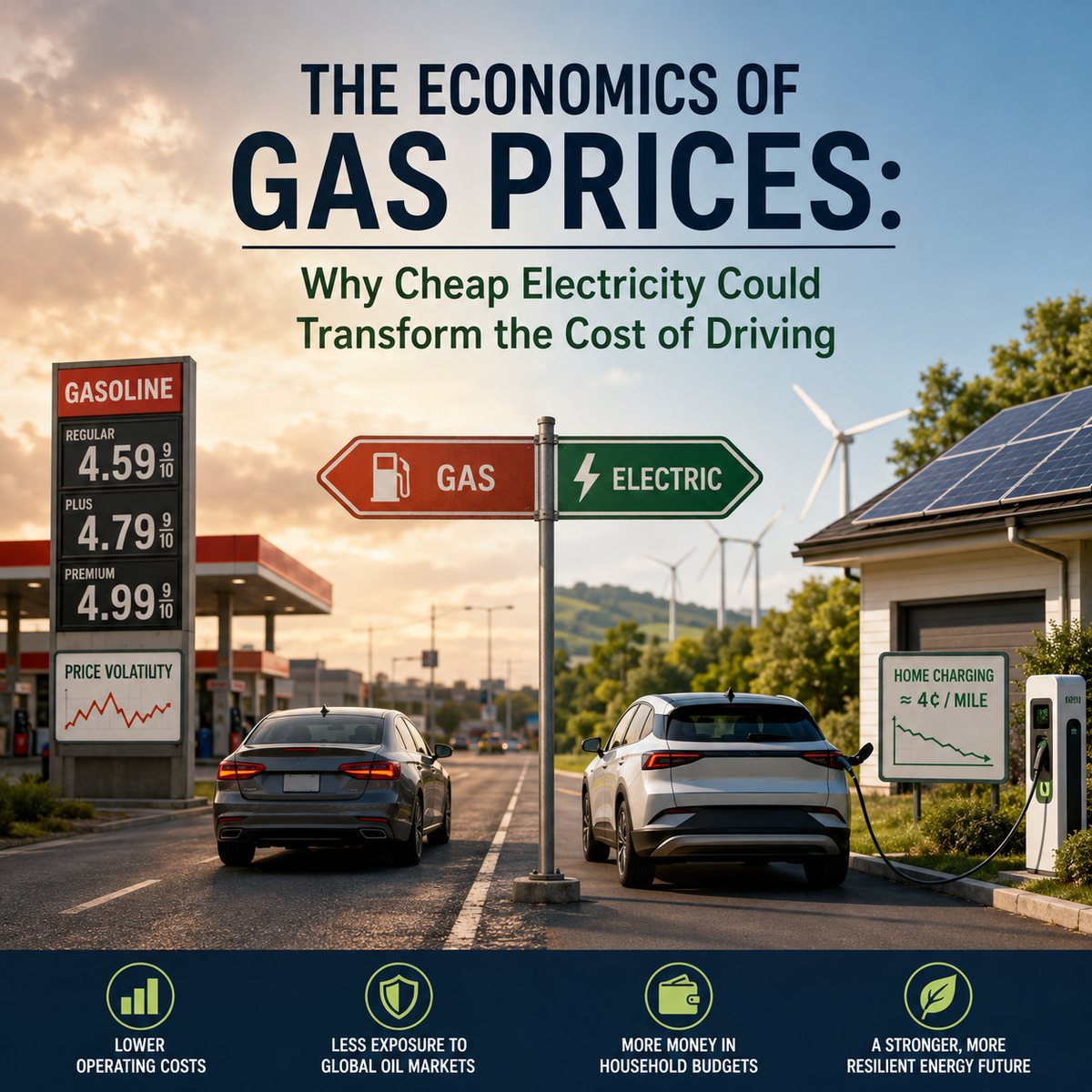
Electric vehicles change that calculation.
The most important economic advantage of an EV isn’t necessarily that electricity is cheap. It is that electric vehicles can convert energy into transportation so much more efficiently that the energy cost per mile can fall dramatically.
For households that drive a lot and can charge at home, the difference can amount to thousands of dollars a year.
And as EV purchase prices move closer to gasoline vehicles, cheap electricity could become one of the biggest opportunities to permanently reduce household transportation expenses.
Stop Thinking About Gas Prices. Think About Cost Per Mile.
Gasoline is normally discussed in dollars per gallon.
Electricity is measured in cents per kilowatt-hour.
Those units make the two energy sources difficult to compare.
The better measurement is:
How much does the energy required to drive one mile cost?
Consider a gasoline vehicle getting 22 miles per gallon.
At $3 gasoline:
$3 ÷ 22 = 13.6 cents per mile
At $4 gasoline:
$4 ÷ 22 = 18.2 cents per mile
At $5 gasoline:
$5 ÷ 22 = 22.7 cents per mile
Now consider an efficient electric vehicle consuming approximately 30 kilowatt-hours for every 100 miles.
If home electricity costs 15 cents per kilowatt-hour:
30 kWh × $0.15 ÷ 100 = 4.5 cents per mile
That creates a striking difference.
| Energy Price | 22-MPG Gas Vehicle | EV at 30 kWh/100 Miles |
|---|---|---|
| $3.00/gallon gas | 13.6¢/mile | — |
| $4.00/gallon gas | 18.2¢/mile | — |
| $5.00/gallon gas | 22.7¢/mile | — |
| 15¢/kWh electricity | — | 4.5¢/mile |
The EV doesn’t need $5 gasoline to have an energy-cost advantage.
It has one even at $3 gasoline.
The real question is whether that operating-cost advantage is large enough to compensate for the purchase price, depreciation, insurance, financing, registration and other costs of owning the EV.
That distinction is important.
What Happens With a 50-Mile Commute?
Consider someone driving 50 miles round trip to work five days a week for 50 weeks.
That’s:
12,500 commuting miles per year.
At 22 mpg and $4 per gallon, gasoline costs approximately:
$2,273 per year.
At $5 per gallon:
$2,841 per year.
An EV using 30 kWh per 100 miles with 15-cent home electricity would cost approximately:
$563 per year.
| Annual Energy Cost — 12,500 Miles | Cost |
| Gas vehicle — $3/gallon | $1,705 |
| Gas vehicle — $4/gallon | $2,273 |
| Gas vehicle — $5/gallon | $2,841 |
| EV — 15¢/kWh | $563 |
At $4 gasoline, that’s approximately $1,710 a year in energy savings.
At $5 gasoline, it’s roughly $2,278.
And that’s just commuting.
High-Mileage Households Change the Equation
Annual mileage may be even more important than the price of gasoline.
Consider someone driving 30,000 miles per year.
A 22-mpg vehicle consumes about 1,364 gallons annually.
At $3 per gallon, that’s approximately:
$4,091 per year.
At $4:
$5,455.
At $5:
$6,818.
Our example EV would consume about 9,000 kWh.
At 15 cents per kWh:
$1,350 per year.
| 30,000 Miles Per Year | Annual Energy Cost |
| Gas — $3/gallon | $4,091 |
| Gas — $4/gallon | $5,455 |
| Gas — $5/gallon | $6,818 |
| EV — 15¢/kWh | $1,350 |
Even with $3 gasoline, that’s about $2,741 per year in energy savings.
At $5 gasoline, the difference approaches $5,500 annually.
This is why blanket statements such as “EVs save money” or “EVs are too expensive” aren’t particularly useful.
The economics depend heavily on how much you drive, what you pay for electricity, what the alternative vehicle gets for fuel economy, and how much more—or less—the EV costs to buy.
Gasoline Also Introduces Price Risk
There is another economic difference between gasoline and residential electricity: exposure to global commodity markets.
Oil is globally traded.
Its price can react rapidly to wars, sanctions, OPEC+ decisions, production disruptions, changes in global demand and geopolitical events.
Crude oil itself has historically represented a substantial portion of the retail price of gasoline.
The U.S. Energy Information Administration estimates that crude oil accounted for slightly more than half of the average retail gasoline price over the previous decade.
Gasoline prices can therefore transmit changes in global oil markets directly into household budgets.
Electricity prices can certainly rise too. Utilities invest in generation, transmission and distribution infrastructure, and those costs ultimately affect customers.
But electricity is a fundamentally different energy system.
A household charging an EV at home is buying energy from an electric grid that can generate power from a mixture of hydroelectricity, natural gas, wind, solar, nuclear and other resources.
Transportation therefore becomes less directly tied to the price of a single globally traded commodity.
The West Coast Illustrates the Problem
This issue is particularly relevant on the West Coast.
The Energy Information Administration expects the West Coast to continue having some of the highest gasoline prices in the country.
The reason isn’t simply crude oil.
Refinery capacity matters too.
EIA reported that U.S. refining capacity declined by more than 250,000 barrels per day between January 2025 and January 2026.
The West Coast is particularly vulnerable because it has relatively limited pipeline connections with the large refining centers on the Gulf Coast.
When West Coast refinery capacity disappears, replacement gasoline may need to arrive from more distant sources.
That can create both higher prices and greater volatility.
Even if global crude prices decline, regional refining constraints can keep West Coast gasoline comparatively expensive.
That is an important distinction when thinking about America’s long-term energy strategy.
Reducing oil prices doesn’t necessarily eliminate gasoline-price risk.
Reducing the amount of gasoline households need does.
The Economic Threshold Isn’t $5 Gas
There is a common assumption that EVs only make economic sense when gasoline becomes extremely expensive.
That’s not necessarily true.
At 15-cent electricity and 30 kWh per 100 miles, our example EV costs about 4.5 cents per mile for energy.
A 30-mpg gasoline vehicle reaches that same energy cost only if gasoline falls to:
$1.35 per gallon.
A 22-mpg vehicle reaches it around:
99 cents per gallon.
That doesn’t mean an EV automatically becomes the cheaper vehicle at today’s gasoline prices.
The purchase price still matters enormously.
But it shows something important:
Once the purchase-price difference between electric and gasoline vehicles becomes small, gasoline vehicles face a structural operating-cost disadvantage.
That could be the economic tipping point for electrification.
Purchase Price Is the Missing Piece
Imagine two comparable new vehicles.
One costs $35,000 and runs on gasoline.
The other costs $45,000 and runs on electricity.
Even if the EV saves $1,500 or $2,000 per year in energy, recovering the additional $10,000 purchase price can take years.
But change the EV price to $36,000 or $37,000 and the economics change dramatically.
Now the buyer isn’t trying to recover a $10,000 premium.
The vehicles are close to purchase-price parity, while one may have a significant operating-cost advantage for every mile driven.
That is why declining battery and manufacturing costs matter so much.
The transition doesn’t require gasoline to become prohibitively expensive.
It requires EVs to become inexpensive enough that consumers no longer have to pay a large premium to access cheaper energy.
Maintenance Adds Another Dimension
Electric vehicles also eliminate several components associated with internal-combustion vehicles.
There are no engine oil changes.
There are no spark plugs.
There is no conventional exhaust system.
There are fewer moving components in the propulsion system.
That doesn’t make EVs maintenance-free. They still require tires, suspension components, cabin filters, wipers, brake maintenance and other services. EV tire costs can also be significant.
But reduced mechanical complexity creates another potential operating-cost advantage.
For a household deciding between keeping a 15- or 20-year-old gasoline vehicle and purchasing a new EV, expected repair costs become part of the break-even calculation.
The Right Question Is: When Do I Break Even?
This is where EV economics should become much more sophisticated.
Instead of asking:
“How much gas will I save?”
Consumers should ask:
“At what point does the EV become less expensive to own?”
A proper break-even calculation should include:
- Purchase price after dealer discounts and incentives
- Value of the vehicle being replaced
- Financing costs
- Annual mileage
- Gasoline vehicle MPG
- Expected gasoline prices
- EV electricity consumption
- Home electricity rates
- Maintenance and expected repairs
- Insurance differences
- Registration and road-use fees
- Expected resale values
- The time value of money
With those inputs, consumers could calculate three extremely useful numbers:
Break-even month
How long before the EV becomes the economically cheaper choice?
Break-even gasoline price
How expensive does gasoline need to be before the EV wins?
Break-even annual mileage
How much driving is required for the lower operating costs to recover the EV’s higher capital cost?
Those three numbers are much more useful than simply saying an EV gets “115 MPGe.”
A Simple EV Break-Even Formula
A quick first-pass calculation starts with energy cost per mile.
For gasoline:
Gas price ÷ MPG = gasoline cost per mile
For an EV:
Electricity price × kWh per mile = electricity cost per mile
Then:
Annual energy savings = (gas cost per mile − EV cost per mile) × annual miles
Suppose the gasoline vehicle costs 18 cents per mile in fuel while the EV costs 5 cents.
The EV saves:
13 cents per mile.
At 10,000 miles:
$1,300 per year
At 15,000 miles:
$1,950
At 20,000 miles:
$2,600
At 30,000 miles:
$3,900
Then maintenance savings, insurance differences and other ownership costs can be added.
Finally, those operating savings should be compared with the EV’s additional depreciation and financing costs.
That gives consumers something much more useful than a fuel-economy sticker:
an estimated economic crossover date.
Oregon Has Already Studied the Household-Energy Opportunity
This isn’t merely theoretical.
Analysis supporting the Oregon Energy Strategy identified transportation electrification as potentially the state’s largest household “energy wallet” savings opportunity.
The analysis also makes an important qualification: vehicle capital costs matter.
In other words, inexpensive electricity alone doesn’t guarantee that replacing a functioning gasoline vehicle today is financially optimal.
When the vehicle is purchased matters.
How much the EV costs matters.
How much the household drives matters.
And the age and value of the vehicle being replaced matter.
That is exactly how consumers should think about the transition.
Cheap Energy Can Function Like a Household Tax Cut
Suppose a household reduces transportation energy spending by $200 per month.
That money doesn’t disappear.
It becomes available for groceries, housing, retirement savings, entertainment, debt repayment or other consumption.
At $300 per month, the effect becomes even larger.
That means transportation electrification potentially has an economic effect beyond the auto industry.
Reducing the amount households spend obtaining energy to move themselves around effectively increases disposable income.
The economic objective shouldn’t simply be:
“Replace gasoline cars with electric cars.”
A better objective would be:
Reduce the amount of household income required to purchase transportation energy.
EVs happen to be one potentially powerful way to accomplish that.
Energy Abundance Is the Bigger Opportunity
There is an even broader lesson here.
For decades, American energy policy has frequently been framed around scarcity:
How do we keep gasoline affordable?
How do we secure enough oil?
How do we respond when global oil markets become unstable?
Electrification creates another possibility.
Instead of focusing exclusively on making gasoline cheaper, policymakers can ask how to make transportation energy itself cheaper.
That means abundant electricity.
It means generation.
It means transmission.
It means grid modernization.
It means inexpensive overnight charging.
It means competition among energy sources.
And it means vehicles efficient enough to turn inexpensive electricity into inexpensive transportation.
The long-term economic opportunity isn’t merely replacing one type of automobile with another.
It is creating an energy system in which moving a person one mile requires significantly less household income.
Gasoline Doesn’t Have to Become Expensive for EVs to Win
This may ultimately be the most important point.
EV adoption doesn’t require gasoline to reach $6, $7 or $8 per gallon.
Gasoline could fall.
Oil markets could stabilize.
Today’s geopolitical disruptions could fade.
In fact, the Energy Information Administration has forecast lower crude oil and gasoline prices as global supply expands.
But West Coast refining constraints demonstrate why gasoline prices can remain regionally elevated even when crude oil becomes cheaper.
More importantly, the EV doesn’t necessarily need gasoline prices to rise.
It needs its purchase price to fall.
Once an electric vehicle costs roughly the same as the gasoline vehicle someone would otherwise buy, a transportation energy cost of 4 or 5 cents per mile becomes difficult to ignore.
That is where electrification stops being primarily an environmental or technological argument.
It becomes an economic one.
The Real EV Tipping Point
The EV tipping point may therefore have much less to do with the price of gasoline than many people assume.
It occurs when three conditions converge:
EV purchase prices approach gasoline-vehicle prices.
Home electricity remains relatively inexpensive.
Consumers drive enough miles for operating savings to matter.
When those conditions are met, the economic question reverses.
Instead of asking:
“Can I afford to switch to an EV?”
Consumers may increasingly ask:
“Why am I continuing to buy gasoline?”
That is the potentially transformative part of transportation electrification.
Cheap electricity doesn’t simply offer another way to power a car.
It offers households the possibility of permanently reducing one of their recurring expenses—and keeping more of their income for everything else.
Back to